[ad_1]
Assuring data system safety requires not simply stopping system compromises but in addition discovering adversaries already current within the community earlier than they’ll assault from the inside. Defensive laptop operations personnel have discovered the strategy of cyber menace looking a vital instrument for figuring out such threats. Nevertheless, the time, expense, and experience required for cyber menace looking typically inhibit the usage of this method. What’s wanted is an autonomous cyber menace looking instrument that may run extra pervasively, obtain requirements of protection at present thought-about impractical, and considerably scale back competitors for restricted time, {dollars}, and naturally analyst assets. On this SEI weblog publish, I describe early work we’ve undertaken to use recreation principle to the event of algorithms appropriate for informing a completely autonomous menace looking functionality. As a place to begin, we’re growing what we consult with as chain video games, a set of video games during which menace looking methods might be evaluated and refined.
What’s Risk Searching?
The idea of menace looking has been round for fairly a while. In his seminal cybersecurity work, The Cuckoo’s Egg, Clifford Stoll described a menace hunt he performed in 1986. Nevertheless, menace looking as a proper observe in safety operations facilities is a comparatively current improvement. It emerged as organizations started to understand how menace looking enhances two different widespread safety actions: intrusion detection and incident response.
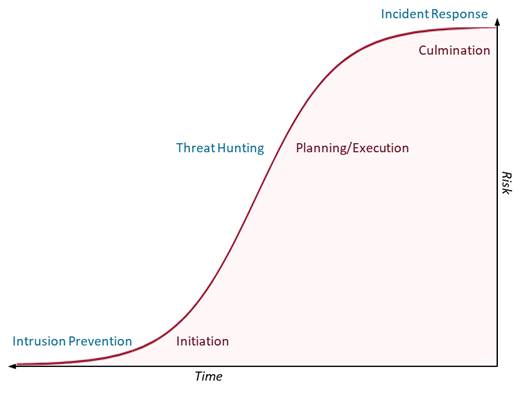
Intrusion detection tries to maintain attackers from stepping into the community and initiating an assault, whereas incident response seeks to mitigate harm achieved by an attacker after their assault has culminated. Risk looking addresses the hole within the assault lifecycle during which an attacker has evaded preliminary detection and is planning or launching the preliminary levels of execution of their plan (see Determine 1). These attackers can do important harm, however the danger hasn’t been absolutely realized but by the sufferer group. Risk looking offers the defender one other alternative to seek out and neutralize assaults earlier than that danger can materialize.
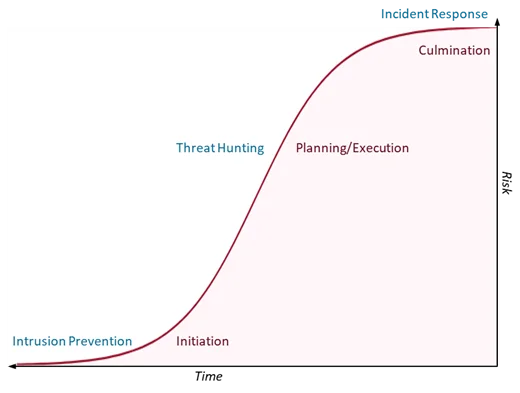
Determine 1: Risk Searching Addresses a Essential Hole within the Assault Lifecycle
Risk looking, nonetheless, requires quite a lot of time and experience. Particular person hunts can take days or perhaps weeks, requiring hunt employees to make robust choices about which datasets and techniques to research and which to disregard. Each dataset they don’t examine is one that would include proof of compromise.
The Imaginative and prescient: Autonomous Risk Searching
Sooner and larger-scale hunts might cowl extra information, higher detect proof of compromise, and alert defenders earlier than the harm is finished. These supercharged hunts might serve a reconnaissance perform, giving human menace hunters data they’ll use to higher direct their consideration. To realize this pace and financial system of scale, nonetheless, requires automation. The truth is, we consider it requires autonomy—the power for automated processes to predicate, conduct, and conclude a menace hunt with out human intervention.
Human-driven menace looking is practiced all through the DoD, however normally opportunistically when different actions, resembling real-time evaluation, allow. The expense of conducting menace hunt operations sometimes precludes thorough and complete investigation of the world of regard. By not competing with real-time evaluation or different actions for investigator effort, autonomous menace looking might be run extra pervasively and held to requirements of protection at present thought-about impractical.
At this early stage in our analysis on autonomous menace looking, we’re targeted within the short-term on quantitative analysis, speedy strategic improvement, and capturing the adversarial high quality of the menace looking exercise.
Modeling the Drawback with Cyber Camouflage Video games
At current, we stay a great distance from our imaginative and prescient of a completely autonomous menace looking functionality that may examine cybersecurity information at a scale approaching the one at which this information is created. To begin down this path, we should be capable to mannequin the issue in an summary method that we (and a future automated hunt system) can analyze. To take action, we would have liked to construct an summary framework during which we might quickly prototype and take a look at menace looking methods, probably even programmatically utilizing instruments like machine studying. We believed a profitable method would mirror the concept that menace looking entails each the attackers (who want to cover in a community) and defenders (who wish to discover and evict them). These concepts led us to recreation principle.
We started by conducting a literature evaluate of current work in recreation principle to determine researchers already working in cybersecurity, ideally in methods we might instantly adapt to our objective. Our evaluate did certainly uncover current work within the space of adversarial deception that we thought we might construct on. Considerably to our shock, this physique of labor targeted on how defenders might use deception, moderately than attackers. In 2018, for instance, a class of video games was developed referred to as cyber deception video games. These video games, contextualized by way of the Cyber Kill Chain, sought to research the effectiveness of deception in irritating attacker reconnaissance. Furthermore, the cyber deception video games had been zero-sum video games, which means that the utility of the attacker and the defender stability out. We additionally discovered work on cyber camouflage video games, that are much like cyber deception video games, however are general-sum video games, which means the attacker and defender utility are not instantly associated and might fluctuate independently.
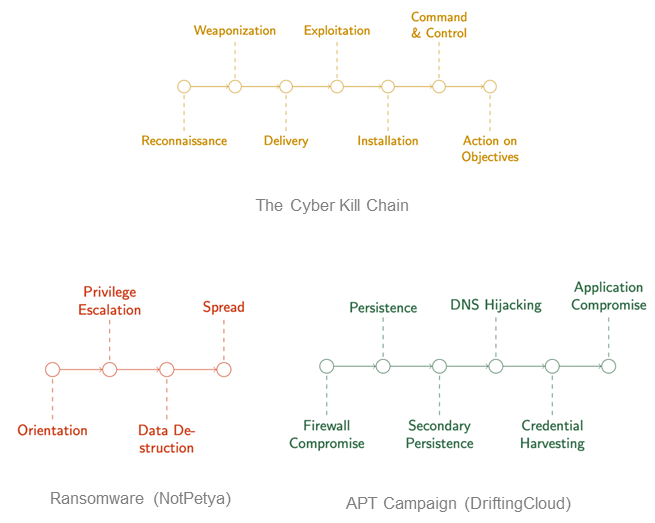
Seeing recreation principle utilized to actual cybersecurity issues made us assured we might apply it to menace looking. Essentially the most influential a part of this work on our analysis considerations the Cyber Kill Chain. Kill chains are an idea derived from kinetic warfare, and they’re normally utilized in operational cybersecurity as a communication and categorization instrument. Kill chains are sometimes used to interrupt down patterns of assault, resembling in ransomware and different malware. A greater method to consider these chains is as assault chains, as a result of they’re getting used for assault characterization.
Elsewhere in cybersecurity, evaluation is finished utilizing assault graphs, which map all of the paths by which a system may be compromised (see Determine 2). You may consider this type of graph as a composition of particular person assault chains. Consequently, whereas the work on cyber deception video games primarily used references to the Cyber Kill Chain to contextualize the work, it struck us as a strong formalism that we might orient our mannequin round.
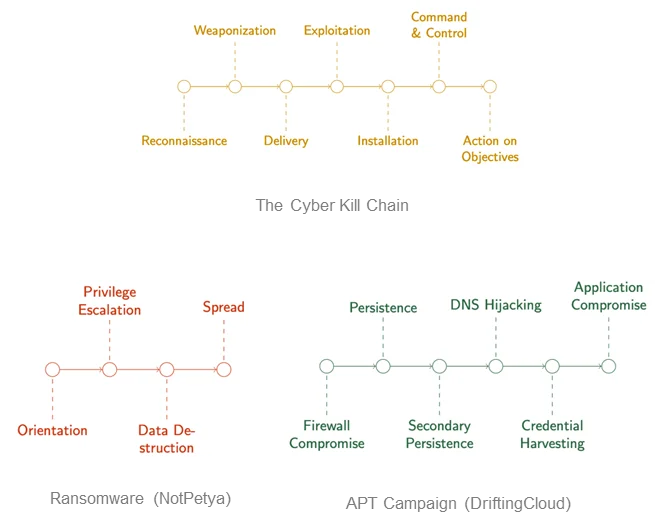
Determine 2: An Assault Graph Using the Cyber Kill Chain
Within the following sections, I’ll describe that mannequin and stroll you thru some easy examples, describe our present work, and spotlight the work we plan to undertake within the close to future.
Easy Chain Video games
Our method to modeling cyber menace looking employs a household of video games we consult with as chain video games, as a result of they’re oriented round a really summary mannequin of the kill chains. We name this summary mannequin a state chain. Every state in a series represents a place of benefit in a community, a pc, a cloud utility, or a variety of different completely different contexts in an enterprise’s data system infrastructure. Chain video games are performed on state chains. States characterize positions within the community conveying benefit (or drawback) to the attacker. The utility and price of occupying a state might be quantified. Progress by way of the state chain motivates the attacker; stopping progress motivates the defender.
You may consider an attacker initially establishing themselves in a single state—“state zero” (see “S0” in Determine 3). Maybe somebody within the group clicked on a malicious hyperlink or an electronic mail attachment. The attacker’s first order of enterprise is to ascertain persistence on the machine they’ve contaminated to ward towards being unintentionally evicted. To ascertain this persistence, the attacker writes a file to disk and makes certain it’s executed when the machine begins up. In so doing, they’ve moved from preliminary an infection to persistence, they usually’re advancing into state one. Every extra step an attacker takes to additional their targets advances them into one other state.
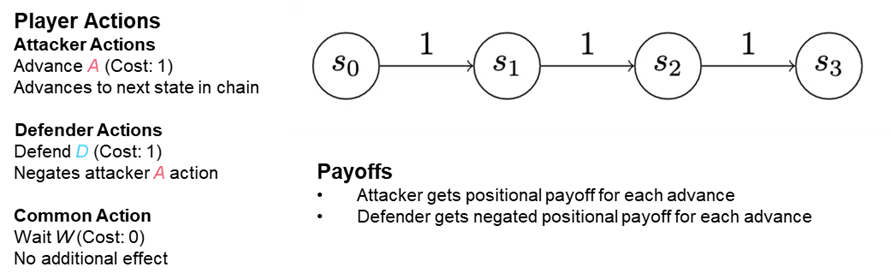
Determine 3: The Genesis of a Risk Searching Mannequin: a Easy Chain Recreation Performed on a State Chain
The sector isn’t large open for an attacker to take these actions. As an example, in the event that they’re not a privileged consumer, they won’t be capable to set their file to execute. What’s extra, making an attempt to take action will reveal their presence to an endpoint safety resolution. So, they’ll must attempt to elevate their privileges and develop into an admin consumer. Nevertheless, that transfer might additionally arouse suspicion. Each actions entail some danger, however additionally they have a possible reward.
To mannequin this example, a price is imposed any time an attacker desires to advance down the chain, however the attacker might alternatively earn a profit by efficiently transferring right into a given state. The defender doesn’t journey alongside the chain just like the attacker: The defender is someplace within the community, in a position to observe (and generally cease) a number of the attacker’s strikes.
All of those chain video games are two-player video games performed between an attacker and a defender, they usually all comply with guidelines governing how the attacker advances by way of the chain and the way the defender may attempt to cease them. The video games are confined to a set variety of turns, normally two or three in these examples, and are principally general-sum video games: every participant good points and loses utility independently. We conceived these video games as simultaneous flip video games: Each gamers resolve what to do on the identical time and people actions are resolved concurrently.
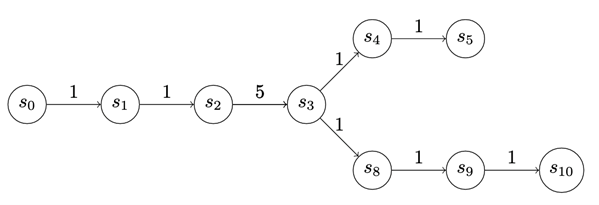
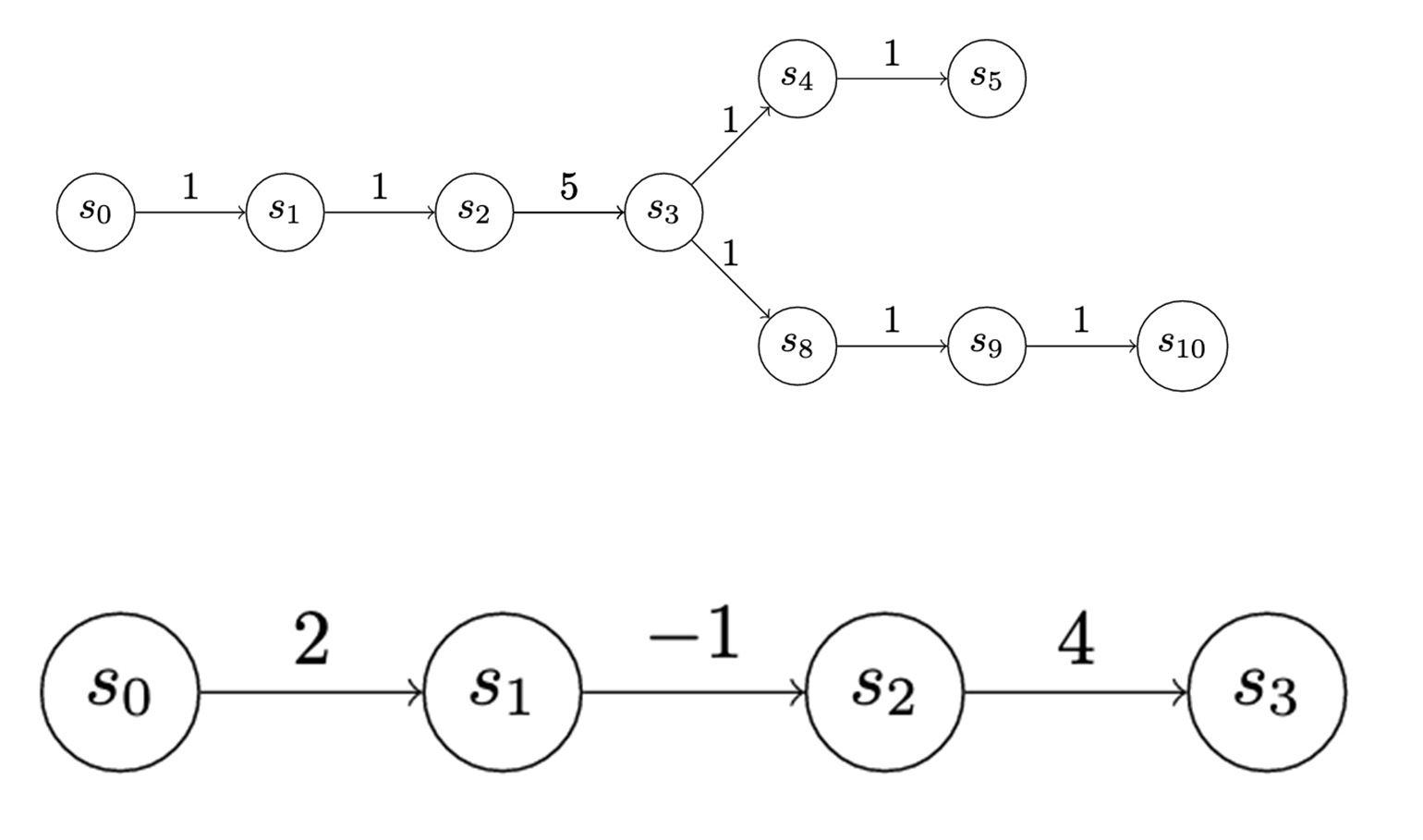
We will additionally apply graphs to trace the play (see Determine 4). From the attacker standpoint, this graph represents a alternative they’ll make about the way to assault, exploit, or in any other case function throughout the defender community. As soon as the attacker makes that alternative, we will consider the trail the attacker chooses as a series. So regardless that the evaluation is oriented round chains, there are methods we will deal with extra complicated graphs to consider them like chains.
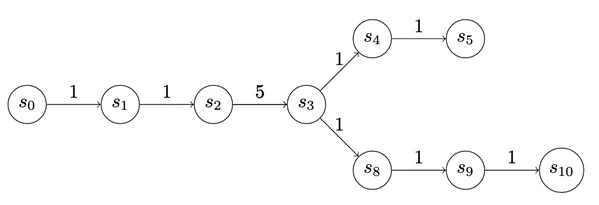
Determine 4: Graph Depicting Attacker Play in a Chain Recreation
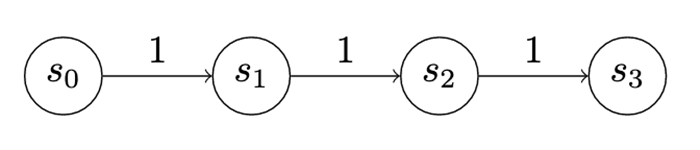
The payoff to enter a state is depicted on the edges of the graphs in Determine 5. The payoff doesn’t must be the identical for every state. We use uniform-value chains for the primary few examples, however there’s really plenty of expressiveness on this value task. As an example, within the chain beneath, S3 could characterize a precious supply of knowledge, however to entry it the attacker could must tackle some web danger.
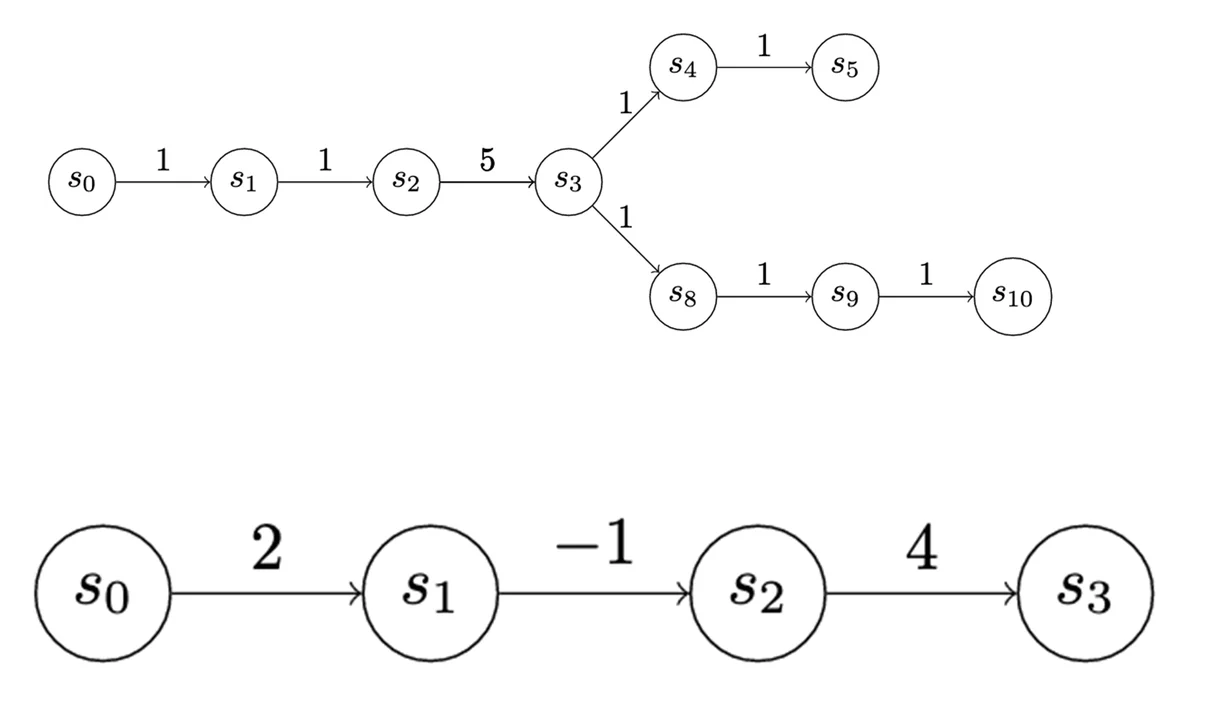
Determine 5: Monitoring the Payoff to the Attacker for Advancing Down the Chain
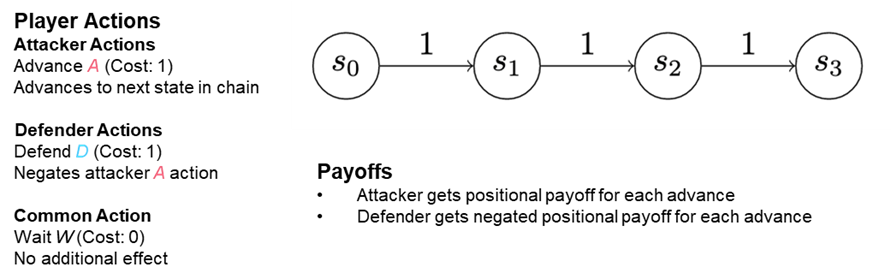
Within the first recreation, which is a quite simple recreation we will name “Model 0,” the attacker and defender have two actions every (Determine 6). The attacker can advance, which means they’ll go from no matter state they’re in to the subsequent state, accumulating the utility for getting into the state and paying the associated fee to advance. On this case, the utility for every advance is 1, which is absolutely offset by the associated fee.
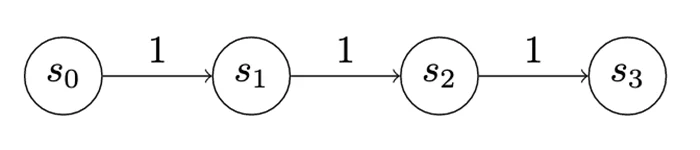
Determine 6: A Easy Recreation, “Model 0,” Demonstrating a Uniform-Worth Chain
Nevertheless, the defender receives -1 utility every time an attacker advances (zero-sum). This scoring isn’t meant to incentivize the attacker to advance a lot as to encourage the defender to train their detect motion. A detect will cease an advance, which means the attacker pays the associated fee for the advance however doesn’t change states and doesn’t get any extra utility. Nevertheless, exercising the detect motion prices the defender 1 utility. Consequently, as a result of a penalty is imposed when the attacker advances, the defender is motivated to pay the associated fee for his or her detect motion and keep away from being punished for an attacker advance. Lastly, each the attacker and the defender can select to wait. Ready prices nothing, and earns nothing.
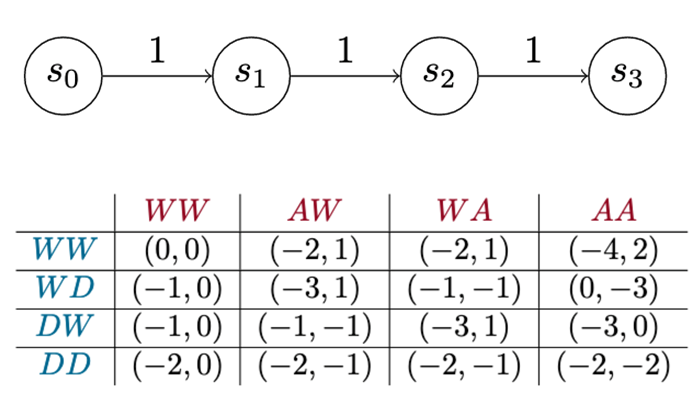
Determine 7 illustrates the payoff matrix of a Model 0 recreation. The matrix exhibits the whole web utility for every participant after they play the sport for a set variety of turns (on this case, two turns). Every row represents the defender selecting a single sequence of actions: The primary row exhibits what occurs when the defender waits for 2 turns throughout all the opposite completely different sequences of actions the attacker can take. Every cell is a pair of numbers that exhibits how properly that works out for the defender, which is the left quantity, and the attacker on the proper.
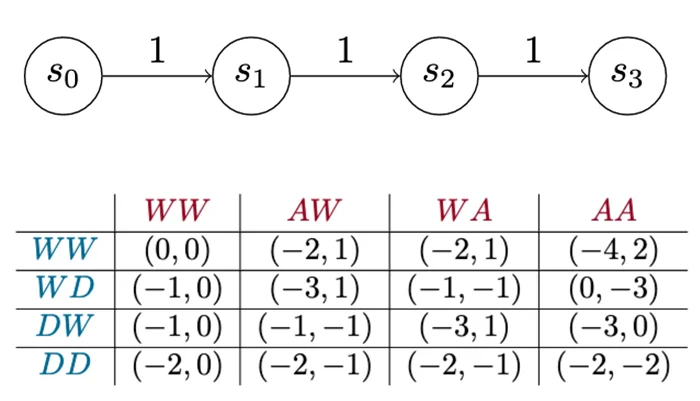
Determine 7: Payoff Matrix for a Easy Assault-Defend Chain Recreation of Two Turns (A=advance; W=wait; D=detect)
This matrix exhibits each technique the attacker or the defender can make use of on this recreation over two turns. Technically, it exhibits each pure technique. With that data, we will carry out different kinds of research, resembling figuring out dominant methods. On this case, it seems there may be one dominant technique every for the attacker and the defender. The attacker’s dominant technique is to all the time attempt to advance. The defender’s dominant technique is, “By no means detect!” In different phrases, all the time wait. Intuitively, it appears that evidently the -1 utility penalty assessed to an attacker to advance isn’t sufficient to make it worthwhile for the defender to pay the associated fee to detect. So, consider this model of the sport as a educating instrument. An enormous a part of making this method work lies in selecting good values for these prices and payouts.
Introducing Camouflage
In a second model of our easy chain recreation, we launched some mechanics that helped us take into consideration when to deploy and detect attacker camouflage. You’ll recall from our literature evaluate that prior work on cyber camouflage video games and cyber deception video games modeled deception as defensive actions, however right here it’s a property of the attacker.
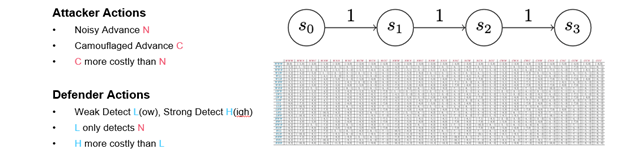
This recreation is an identical to Model 0, besides every participant’s major motion has been cut up in two. As an alternative of a single advance motion, the attacker has a noisy advance motion and a camouflaged advance motion. Consequently, this model displays tendencies we see in precise cyber assaults: Some attackers attempt to take away proof of their exercise or select strategies which may be much less dependable however tougher to detect. Others transfer boldly ahead. On this recreation, that dynamic is represented by making a camouflaged advance extra expensive than a noisy advance, however it’s tougher to detect.
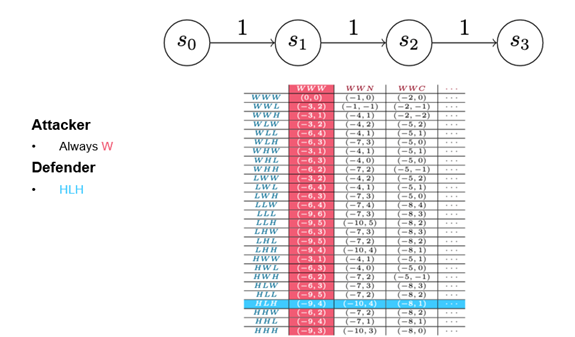
On the defender aspect, the detect motion now splits right into a weak detect and a robust detect. A weak detect can solely cease noisy advances; a robust detect can cease each sorts of attacker advance, however–after all–it prices extra. Within the payout matrix (Determine 8), weak and robust detects are known as high and low detections. (Determine 8 presents the full payout matrix. I don’t count on you to have the ability to learn it, however I wished to supply a way of how shortly easy modifications can complicate evaluation.)
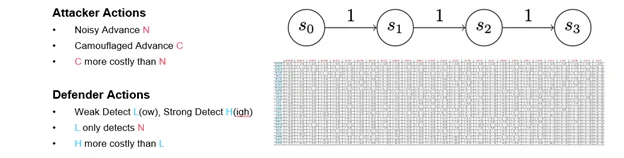
Determine 8: Payout Matrix in a Easy Chain Recreation of Three Turns with Added Assault and Detect Choices
Dominant Technique
In recreation principle, a dominant technique will not be the one which all the time wins; moderately, a technique is deemed dominant if its efficiency is the most effective you’ll be able to count on towards a superbly rational opponent. Determine 9 offers a element of the payout matrix that exhibits all of the defender methods and three of the attacker methods. Regardless of the addition of a camouflaged motion, the sport nonetheless produces one dominant technique every for each the attacker and the defender. We’ve tuned the sport, nonetheless, in order that the attacker ought to by no means advance, which is an artifact of the way in which we’ve chosen to construction the prices and payouts. So, whereas these explicit methods mirror the way in which the sport is tuned, we’d discover that attackers in actual life deploy methods apart from the optimum rational technique. In the event that they do, we’d wish to alter our conduct to optimize for that state of affairs.
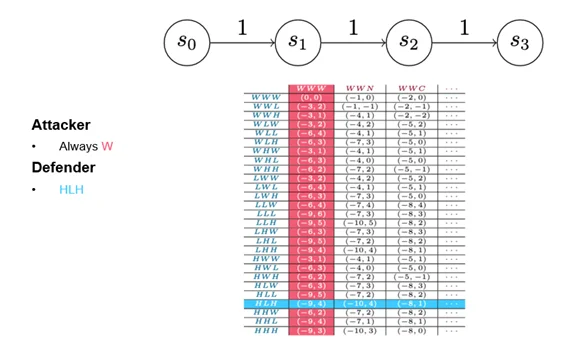
Determine 9: Detailed View of Payout Matrix Indicating Dominant Technique
Extra Complicated Chains
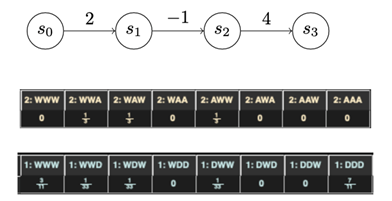
The 2 video games I’ve mentioned so far had been performed on chains with uniform development prices. Once we fluctuate that assumption, we begin to get far more attention-grabbing outcomes. As an example, a three-state chain (Determine 10) is a really affordable characterization of sure sorts of assault: An attacker will get plenty of utility out of the preliminary an infection, and sees plenty of worth in taking a selected motion on targets, however stepping into place to take that motion could incur little, no, and even unfavorable utility.
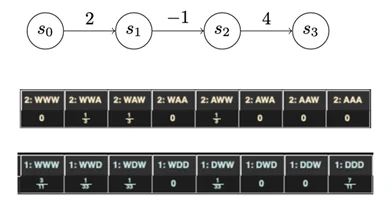
Determine 10: Illustration of a Three-State Chain from the Gambit Recreation Evaluation Device
Introducing chains with complicated utilities yields far more complicated methods for each attacker and defender. Determine 10 is derived from the output of Gambit, which is a recreation evaluation instrument, that describes the dominant methods for a recreation performed over the chain proven beneath. The dominant methods at the moment are blended methods. A blended technique implies that there isn’t a “proper technique” for any single playthrough; you’ll be able to solely outline optimum play by way of chances. As an example, the attacker right here ought to all the time advance one flip and wait the opposite two turns. Nevertheless, the attacker ought to combine it up after they make their advance, spreading them out equally amongst all three turns.
This payout construction could mirror, for example, the implementation of a mitigation of some kind in entrance of a precious asset. The attacker is deterred from attacking the asset by the mitigation. However they’re additionally getting some utility from making that first advance. If that utility had been smaller, for example as a result of the utility of compromising one other a part of the community was mitigated, maybe it might be rational for the attacker to both attempt to advance all the way in which down the chain or by no means attempt to advance in any respect. Clearly, extra work is required right here to higher perceive what’s occurring, however we’re inspired by seeing this extra complicated conduct emerge from such a easy change.
Future Work
Our early efforts on this line of analysis on automated menace looking have recommended three areas of future work:
- enriching the sport area
- simulation
- mapping to the issue area
We focus on every of those areas beneath.
Enriching the Recreation Area to Resemble a Risk Hunt
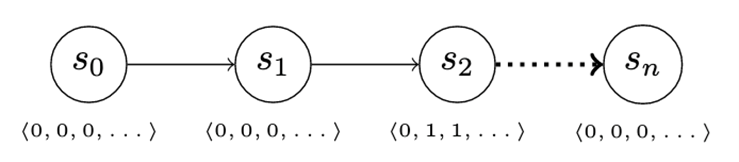
Risk looking normally occurs as a set of information queries to uncover proof of compromise. We will mirror this motion in our recreation by introducing an data vector. The knowledge vector modifications when the attacker advances, however not all the knowledge within the vector is robotically out there (and due to this fact invisible) to the defender. As an example, because the attacker advances from S0 to S1 (Determine 11), there isn’t a change within the data the defender has entry to. Advancing from S1 to S2 modifications a number of the defender-visible information, nonetheless, enabling them to detect attacker exercise.
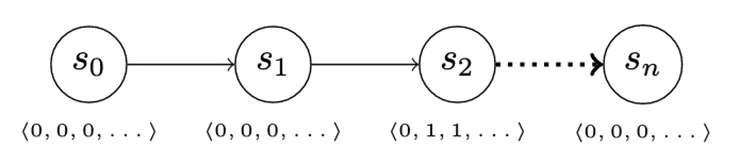
Determine 11: Info Vector Permits for Stealthy Assault
The addition of the knowledge vector permits a variety of attention-grabbing enhancements to our easy recreation. Deception might be modeled as a number of advance actions that differ within the components of the knowledge vector that they modify. Equally, the defender’s detect actions can acquire proof from completely different components of the vector, or maybe unlock components of the vector to which the defender usually has no entry. This conduct could mirror making use of enhanced logging to processes or techniques the place compromise could also be suspected, for example.
Lastly, we will additional defender actions by introducing actions to remediate an attacker presence; for instance, by suggesting a bunch be reinstalled, or by ordering configuration modifications to a useful resource that make it harder for the attacker to advance into.
Simulation
As proven within the earlier instance video games, small issues may end up in many extra choices for participant conduct, and this impact creates a bigger area during which to conduct evaluation. Simulation can present approximate helpful details about questions which are computationally infeasible to reply exhaustively. Simulation additionally permits us to mannequin conditions during which theoretical assumptions are violated to find out whether or not some theoretically suboptimal methods have higher efficiency in particular situations.
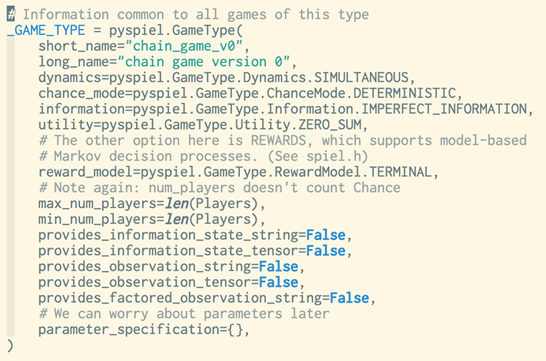
Determine 12 presents the definition of model 0 of our recreation in OpenSpiel, a simulation framework from DeepMind. We plan to make use of this instrument for extra energetic experimentation within the coming yr.
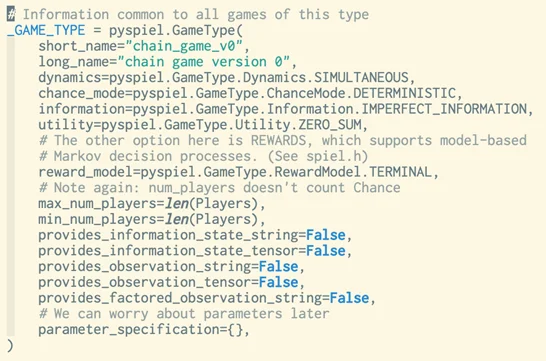
Determine 12: Recreation Specification Created with OpenSpiel
Mapping the Mannequin to the Drawback of Risk Searching
Our final instance recreation illustrated how we will use completely different advance prices on state chains to higher mirror patterns of community safety and patterns of attacker conduct. These patterns fluctuate relying on how we select to interpret the connection of the state chain to the attacking participant. Extra complexity right here leads to a a lot richer set of methods than the uniform-value chains do.
There are different methods we will map primitives in our video games to extra elements of the real-world menace looking drawback. We will use simulation to mannequin empirically noticed methods, and we will map options within the data vector to data components current in real-world techniques. This train lies on the coronary heart of the work we plan to do within the close to future.
Conclusion
Guide menace looking methods at present out there are costly, time consuming, useful resource intensive, and depending on experience. Sooner, cheaper, and fewer resource-intensive menace looking methods would assist organizations examine extra information sources, coordinate for protection, and assist triage human menace hunts. The important thing to quicker, cheaper menace looking is autonomy. To develop efficient autonomous menace looking methods, we’re growing chain video games, that are a set of video games we use to guage menace looking methods. Within the close to time period, our targets are modeling, quantitatively evaluating and growing methods, speedy strategic improvement, and capturing the adversarial high quality of menace looking exercise. In the long run, our objective is an autonomous menace looking instrument that may predict adversarial exercise, examine it, and draw conclusions to tell human analysts.
[ad_2]