



[ad_1]

30-second abstract:
- Decreasing reliance on canonical tags can enhance product URL discovery on Shopify
- The way you construction your merchandise on Shopify can decide how nicely these pages carry out
- Shifting reliance from canonical tags to wealthy inside anchor textual content helps construct relevancy
Can something cease the relentless rise of Shopify? Again in 2012, the panorama was dominated by WordPress, Magento, and Joomla. Quick-forward 10 years and lots of within the business now see Shopify because the main ecommerce platform, with the others going from leaders to laggards.
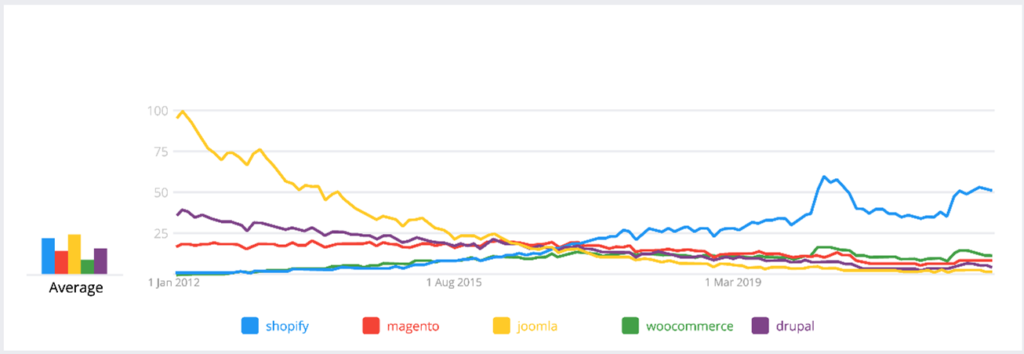
There are after all a number of causes for Shopify’s rise to prominence, however arguably one of many greatest components is that the platform is way more technically accessible than different ecommerce infrastructure suppliers. Getting your head round a contemporary Magento set up or understanding how Joomla works (which continues to be a thriller to me until date!) typically requires a sure degree of technical know-how. And, when you don’t possess it, then you could spend additional sources outsourcing that work to somebody who does.
Shopify understood that baking simplicity and an “it simply works” ethos into their platform would enable on a regular basis entrepreneurs to get their websites up and operating rapidly, with no need a level in laptop science or an enormous price range to keep up their on-line presence. Nevertheless, as user-friendly, because it is likely to be, there are nonetheless a number of technical and web optimization hurdles to beat if you’d like your Shopify web site to succeed on the SERPs.
On this article, I’ll take a more in-depth take a look at a key “out of the field” web optimization concern that usually limits the relevance of product pages inside Shopify and creates vital web site bloat. Extra importantly, I’ll additionally share 4 potential options that can be utilized to repair the issue and maximize your product web page potential. Let’s dive in.
The price of inefficiency
One thing that we frequently focus on with our purchasers is making certain that Google can crawl their web sites as effectively as doable. We clarify this by breaking down the associated fee to Google of crawling the net. Each time Google visits a webpage on the Web there’s a bodily price to Google: the value of electrical energy consumption, water consumption, {hardware}, software program, and all the opposite belongings wanted to go to that web page. Whereas this price is likely to be a thousandth of a penny per URL, with the sheer quantity of URLs crawled by Google every day, the full price is probably going staggering.
Due to this fact, if you’re serving Google webpages which might be duplicated or not related, you’re losing sources. Google has made some extent of stating that of their article on managing crawl price range:
“With out steerage from you, Googlebot will attempt to crawl all or a lot of the URLs that it is aware of about in your web site. If many of those URLs are duplicates, otherwise you don’t need them crawled for another purpose (eliminated, unimportant, and so forth), this wastes a variety of Google crawling time in your web site. That is the issue that you could positively management probably the most.”
The important thing message right here is that you could management how a lot of Google’s crawl time is wasted. By aiming to cut back this waste, you’re making certain that the time Google spends in your web site is as productive as doable. This implies Google will spend extra time crawling URLs which have true worth, choosing up adjustments to present URLs, and discovering new pages a lot sooner.
Use canonicals as a brief answer and never the ultimate repair
A canonical tag is used when there are a number of duplicate pages, permitting you to outline which of the duplicates must be deemed the right web page for Google to index.
Whereas they’re efficient within the brief time period, the existence of a canonical tag highlights that there are structural points inside a web site, and this will affect crawl effectivity. Although the canonical tag will point out to Google that you’ve got chosen a most well-liked URL to index, the search engine nonetheless must crawl all duplicates that comprise the canonical tag to return to the consensus that you’ve got set.
Fairly than utilizing a canonical tag as a everlasting answer, it’s essential to take steps to repair the underlying structural drawback, subsequently negating the usage of a canonical tag. This in flip may have a optimistic affect on crawl effectivity.
What does this need to do with Shopify product pages?
Put merely, product URLs on Shopify depend on canonical tags to be found. Let’s take a look at the 2 predominant causes of this.
Merchandise in a number of collections
The URL beneath is a product web page from a Shopify web site.
You’ll discover that the URL has the gathering the product is in is seen within the URL as nicely. If this product is in a number of collections, Shopify creates a number of product URLs. As these are duplicates, Shopify handles this by utilizing canonical tags. These canonical tags level to the popular product URL, which doesn’t comprise a group:
The product highlighted above is at present in 4 collections, that means there are actually 5 completely different product URLs for Google to crawl to seek out this one product that it must index. There may be, nonetheless, one other concern that additional will increase this quantity: product variants.
Product variants
A product variant is a product attribute that may implement inside Shopify. This could possibly be colour, dimension, weight, or some other kind of attribute {that a} product could have. Creating variants of a product inside Shopify permits a consumer to pick out attributes on the product web page. This may be seen beneath on our instance product URL as “dimension”:
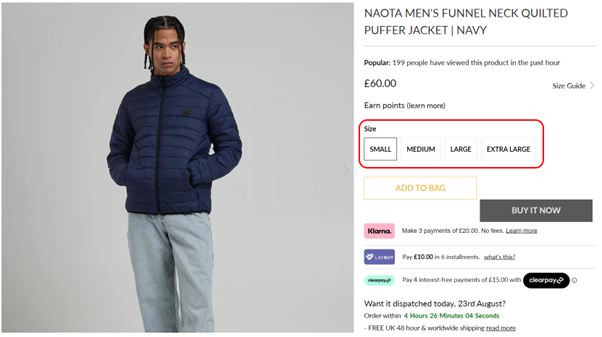
On this setup, Shopify provides a parameter to the product URL referred to as ?variant. This accommodates an ID that references the chosen variant. The URL beneath is our instance product URL with the medium variant chosen:
That is after all one other duplicate, which is dealt with through a canonical tag. If we start to calculate the full variety of URLs this single product has that depend on canonical tags, you’ll discover how this will have a detrimental affect on crawl effectivity.
Primarily based on this product being in 4 collections and having 4 variants, there are a complete of 20 product URLs that depend on a canonical tag. This implies Google must frequently crawl 21 product URLs to find the only product URL that wants indexing.
10,000 URLs crawled to index 600
While you issue within the sheer variety of merchandise throughout a whole web site, it’s simple to see how this determine can add up. If our instance web site has 600 merchandise, and every product seems in 4 collections with 4 variants every, then Google might want to frequently crawl in extra of 10,000 product URLs to seek out the 600 which have been requested to be listed.
How do you repair this on Shopify?
There are two distinct issues we have to repair right here: the difficulty with merchandise showing in a number of collections, and the difficulty with product variants. There are answers for each — nonetheless, implementing them would require compromise in sure areas.
Merchandise in a number of collections: The repair
This repair works by eradicating hyperlinks to product URLs with the gathering identify within the product URL. The primary wrongdoer right here is the gathering URL — particularly the theme file that powers assortment URLs. On Shopify, this file is known as product-grid-item.liquid.
You may navigate to this file through the next route inside your Shopify admin.
On-line Retailer > Themes > Customise > Theme Actions > Edit Code > Snippets
Inside this file there are HTML hyperlinks that reference product URLs containing the gathering identify:

The “inside: assortment” component is what’s answerable for pulling the gathering identify into the product URL. Eradicating this ensures that the gathering identify now not seems within the product URL.
Nevertheless, earlier than you bounce in, there are some things you’ll want to keep in mind:
- It’s endorsed that you just seek the advice of together with your net growth staff earlier than making this alteration.
- Apps that you just use may have the “inside: assortment” performance, so it’s value checking with app assist on whether or not or not this may be modified.
- This transformation impacts the breadcrumb on product URLs. If that is problematic, then I’d recommend constructing breadcrumbs manually utilizing META fields with a devoted META fields app.
- Additionally, you will want to make sure that guide hyperlinks that use this format are modified.
- There could also be different template information that comprise “inside: assortment” so it’s value liaising together with your growth staff to determine these.
Product variants: The repair (or is it?)
Sadly, the answer to product variants is extra advanced and in the end is determined by how a lot web optimization worth you’re getting out of your present product variants. The advice right here is to first learn the way viable product variant key phrases are when it comes to search quantity and market alternative.
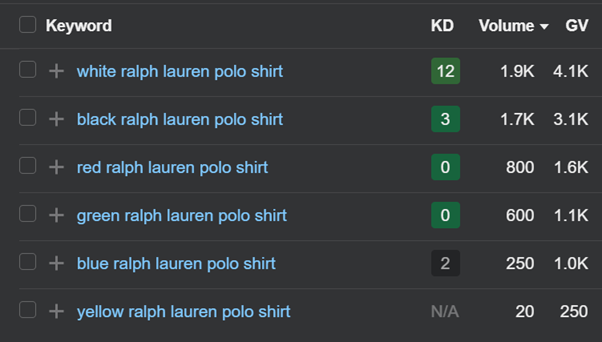
For instance, if our imaginary Shopify retailer sells Ralph Lauren polo shirts, then my variants are prone to be colour and dimension. By operating a fast seek for the product kind plus these variants, we will see that there’s search quantity and subsequently it will likely be essential that my variants are indexable and optimized.
Repair Choice #1: Optimize ?variant URLs
This primary choice is viable when you imagine that there’s search quantity alternative throughout a variety of your product variants. The premise of this repair is to construct logic into your theme code, in order that when a variant is chosen, the variant identify is appended into the web page title tag and the place doable, the product description.
This transformation will seemingly rely in your theme setup and, as with all change, it is strongly recommended that you just seek the advice of together with your net growth staff. Extra particulars on how to do that will be discovered through the Shopify neighborhood thread beneath:
One other factor to keep in mind with this answer is that you’ll want to take away the canonical tag that’s at present in place on ?variant URLs. The primary downside to this method is that you could be must implement it sitewide throughout all product variants — however not all variants will essentially have out there search quantity.
Repair Choice #2: Optimize predominant product URL for variants
In order for you extra management over which product units have optimized variants, then this feature is likely to be for you. By optimizing the principle product URL for variants, by together with variant key phrases within the product description and META knowledge, you’ll stand an opportunity of being seen for these product variant key phrases.
The disadvantage right here is that product URLs may develop into over-optimized and never as related as a devoted, optimized product variant URL.
Repair Choice #3: Disallow ?variant parameter
If it seems that your product variants have minimal or no search worth then disallowing the ?variant parameter in your robots.txt file is likely to be the best choice. It will cease Google crawling ?variant URLs, subsequently making crawl exercise extra environment friendly.
Repair Choice #4: Particular person merchandise per variant
In case your product variants do have search viability, then creating particular person merchandise per variant is likely to be an efficient choice. That is one thing we’ve got seen retailers like Gymnasium Shark do with colour. The product beneath is available in numerous completely different colours, every of which has its personal product URL and doesn’t depend on variants, e.g.:
https://www.gymshark.com/merchandise/gymshark-element-baselayer-t-shirt-black-aw21

With extra management over each META knowledge and optimized content material, this method means it’s simpler to construct deeper relevance for product variants. The draw back right here is that there are merely extra merchandise to handle throughout the CMS.
Shopify & web optimization points: Ultimate ideas
As I discussed earlier, one of many causes for Shopify’s meteoric rise has been the “it simply works” ethos that makes the platform such a cinch to make use of. However that’s to not say that the platform doesn’t undergo from a number of web optimization snags.
Along with the canonical concern, Google’s Core Internet Vitals will be one other supply of complications for SEOs who work with the platform. However there are typically workarounds for individuals who are prepared to take the time to implement them. You may be taught extra about easy methods to navigate these in our final information to Shopify web optimization (2022).
There are additionally hopeful indicators that the Shopify staff are more and more receptive to the wants of the web optimization neighborhood. The staff have frequently taken on board suggestions from SEOs to enhance their product, from permitting customers to edit the robots.txt file, to permitting for sub-folder worldwide constructions. So, we will hope that easy-to-implement options round the usage of canonicals and different points will likely be rolled out earlier than too lengthy.
Can something cease the relentless rise of Shopify? Again in 2012, the panorama was dominated by WordPress, Magento and Joomla. Quick-forward 10 years, and lots of within the business now see Shopify because the main e-commerce platform, with the others going from leaders to laggards.
There are after all a number of causes for Shopify’s rise to prominence, however arguably one of many greatest components is that the platform is way more technically accessible than different ecommerce infrastructure suppliers. Getting your head round a contemporary Magento set up or understanding how Joomla works (which continues to be a thriller to me to this present day!) typically requires a sure degree of technical knowhow. And, when you don’t possess it, then you could spend additional sources outsourcing that work to somebody who does.
Shopify understood that baking in simplicity and an “it simply works” ethos into their platform would enable on a regular basis entrepreneurs to get their websites up and operating rapidly, with no need a level in laptop science or an enormous price range to keep up their on-line presence. Nevertheless, as user-friendly because it is likely to be, there are nonetheless a number of technical and web optimization hurdles to beat if you’d like your Shopify web site to succeed on the SERPs.
On this article, I’ll take a more in-depth take a look at a key “out of the field” web optimization concern that usually limits the relevance of product pages inside Shopify and creates vital web site bloat. Extra importantly, I’ll additionally share 4 potential options that can be utilized to repair the issue and maximize your product web page potential. Let’s dive in.
The price of inefficiency
One thing that we frequently focus on with our purchasers is making certain that Google can crawl their web sites as effectively as doable. We clarify this by breaking down the associated fee to Google of crawling the net. Each time Google visits a webpage on the Web there’s a bodily price to Google: the value of electrical energy consumption, water consumption, {hardware}, software program, and all the opposite belongings wanted to go to that web page. Whereas this price is likely to be a thousandth of a penny per URL, with the sheer quantity of URLs crawled by Google every day, the full price is probably going staggering.
Due to this fact, if you’re serving Google webpages which might be duplicated or not related, you’re losing sources. Google have made some extent of stating that of their article on managing crawl price range:
“With out steerage from you, Googlebot will attempt to crawl all or a lot of the URLs that it is aware of about in your web site. If many of those URLs are duplicates, otherwise you don’t need them crawled for another purpose (eliminated, unimportant, and so forth), this wastes a variety of Google crawling time in your web site. That is the issue that you could positively management probably the most.”
The important thing message right here is that you could management how a lot of Google’s crawl time is wasted. By aiming to cut back this waste, you’re making certain that the time Google spends in your web site is as productive as doable. This implies Google will spend extra time crawling URLs which have true worth, choosing up adjustments to present URLs and discovering new pages a lot sooner.
Utilizing canonicals as a brief answer and never the ultimate repair
A canonical tag is used when there are a number of duplicate pages, permitting you to outline which of the duplicates must be deemed the right web page for Google to index.
Whereas they’re efficient within the brief time period, the existence of a canonical tag highlights that there are structural points inside a web site, and this will affect crawl effectivity. Although the canonical tag will point out to Google that you’ve got chosen a most well-liked URL to index, the search engine nonetheless must crawl all duplicates that comprise the canonical tag to return to the consensus that you’ve got set.
So, relatively than utilizing a canonical tag as a everlasting answer, it’s essential to take steps to repair the underlying structural drawback, and subsequently negating the usage of the canonical tag. This in flip may have a optimistic affect on crawl effectivity.
What does this need to do with Shopify product pages?
Put merely, product URLs on Shopify depend on canonical tags to be found. Let’s take a look at the 2 predominant causes of this.
Merchandise in a number of collections
The URL beneath is a product web page from a Shopify web site.
You’ll discover that the URL has the gathering the product is in inside it. If this product is in a number of collections, Shopify creates a number of product URLs. As these are duplicates, Shopify handles this by utilizing canonical tags. These canonical tags level to the popular product URL, which doesn’t comprise a group:
The product highlighted above is at present in 4 collections, that means there are actually 5 completely different product URLs for Google to crawl to seek out this one product that it must index. There may be, nonetheless, one other concern that additional will increase this quantity: product variants.
Product variants
A product variant is a product attribute that may implement inside Shopify. This could possibly be colour, dimension, weight or some other kind of attribute {that a} product could have. By creating variants of a product inside Shopify, it permits a consumer to pick out attributes on the product web page. This may be seen beneath on our instance product URL as “dimension”:
On this setup, Shopify provides a parameter to the product URL referred to as ?variant. This accommodates an ID that references the chosen variant. The URL beneath is our instance product URL with the medium variant chosen:
That is after all one other duplicate, which is dealt with through a canonical tag. If we start to calculate the full variety of URLs this single product has that depend on canonical tags, you’ll start see how this will have a detrimental affect on crawl effectivity.
Primarily based on this product being in 4 collections and having 4 variants, there are a complete of 20 product URLs that depend on a canonical tag. This implies Google must frequently crawl 21 product URLs to find the only product URL that wants indexing.
10,000 URLs crawled to index 600
While you issue within the sheer variety of merchandise throughout a whole web site, it’s simple to see how this determine can add up. If our instance web site has 600 merchandise, and every product seems in 4 collections with 4 variants every, then Google might want to frequently crawl in extra of 10,000 product URLs to seek out the 600 which have been requested to be listed.
How do you repair this on Shopify?
There are two distinct issues we have to repair right here: the difficulty with merchandise showing in a number of collections, and the difficulty with product variants. There are answers for each — nonetheless, implementing them would require compromise in sure areas.
Merchandise in a number of collections: The repair
This repair works by eradicating hyperlinks to product URLs with the gathering identify within the product URL. The primary wrongdoer right here is the gathering URL — particularly the theme file that powers assortment URLs. On Shopify, this file is known as product-grid-item.liquid.
You may navigate to this file through the next route inside your Shopify admin.
On-line Retailer > Themes > Customise > Theme Actions > Edit Code > Snippets
Inside this file there are HTML hyperlinks that reference product URLs containing the gathering identify:
The “inside: assortment” component is what’s answerable for pulling the gathering identify into the product URL. Eradicating this ensures that the gathering identify now not seems within the product URL.
Nevertheless, earlier than you bounce in, there are some things you’ll want to keep in mind:
- It’s endorsed that you just seek the advice of together with your net growth staff earlier than making this alteration.
- Apps that you just use may have the “inside: assortment” performance, so it’s value checking with app assist on whether or not or not this may be modified.
- This transformation impacts the breadcrumb on product URLs. If that is problematic, then I’d recommend constructing breadcrumbs manually utilizing META fields with a devoted META fields app.
- Additionally, you will want to make sure that guide hyperlinks that use this format are modified.
- There could also be different template information that comprise “inside: assortment” so it’s value liaising together with your growth staff to determine these.
Product variants: The repair (or is it?)
Sadly, the answer to product variants is extra advanced and in the end is determined by how a lot web optimization worth you’re getting out of your present product variants. The advice right here is to first learn the way viable product variant key phrases are when it comes to search quantity and market alternative.
For instance, if our imaginary Shopify retailer sells Ralph Lauren polo shirts, then my variants are prone to be colour and dimension. By operating a fast seek for the product kind plus these variants, we will see that there’s search quantity and subsequently it will likely be essential that my variants are indexable and optimized.
Repair Choice #1: Optimize ?variant URLs
This primary choice is viable when you imagine that there’s search quantity alternative throughout a variety of your product variants. The premise of this repair is to construct logic into your theme code, in order that when a variant is chosen, the variant identify is appended into the web page title tag and the place doable, the product description.
This transformation will seemingly rely in your theme setup and, as with all change, it is strongly recommended that you just seek the advice of together with your net growth staff. Extra particulars on how to do that will be discovered through the Shopify neighborhood thread beneath:
One other factor to keep in mind with this answer is that you’ll want to take away the canonical tag that’s at present in place on ?variant URLs. The primary downside to this method is that you could be must implement it sitewide throughout all product variants — however not all variants will essentially have out there search quantity.
Repair Choice #2: Optimize predominant product URL for variants
In order for you extra management over which product units have optimized variants, then this feature is likely to be for you. By optimizing the principle product URL for variants, by together with variant key phrases within the product description and META knowledge, you’ll stand an opportunity of being seen for these product variant key phrases.
The disadvantage right here is that product URLs may develop into over-optimized and never as related as a devoted, optimized product variant URL.
Repair Choice #3: Disallow ?variant parameter
If it seems that your product variants have minimal or no search worth then disallowing the ?variant parameter in your robots.txt file is likely to be the best choice. It will cease Google crawling ?variant URLs, subsequently making crawl exercise extra environment friendly.
Repair Choice #4: Particular person merchandise per variant
In case your product variants do have search viability, then creating particular person merchandise per variant is likely to be an efficient choice. That is one thing we’ve got seen retailers like Gymnasium Shark do with colour. The product beneath is available in numerous completely different colours, every of which has its personal product URL and doesn’t depend on variants, e.g.:
https://www.gymshark.com/merchandise/gymshark-element-baselayer-t-shirt-black-aw21
With extra management over each META knowledge and optimized content material, this method means it’s simpler to construct deeper relevance for product variants. The draw back right here is that there are merely extra merchandise to handle throughout the CMS.
Shopify & web optimization points: Ultimate ideas
As I discussed earlier, one of many causes for Shopify’s meteoric rise has been the “it simply works” ethos that makes the platform such a cinch to make use of. However that’s to not say that the platform doesn’t undergo from a number of web optimization snags.
Along with the canonical concern, Google’s Core Internet Vitals will be one other supply of complications for SEOs who work with the platform. However there are typically workarounds for individuals who are prepared to take the time to implement them. You may be taught extra about easy methods to navigate these in our final information to Shopify web optimization (2022).
There are additionally hopeful indicators that the Shopify staff are more and more receptive to the wants of the web optimization neighborhood. The staff have frequently taken on board suggestions from SEOs to enhance their product, from permitting customers to edit the robots.txt file, to permitting for sub-folder worldwide constructions. So, we will hope that easy-to-implement options round the usage of canonicals and different points will likely be rolled out earlier than too lengthy.
Marc Swann is Director of Search at Glass Digital, a digital advertising company providing web optimization, affiliate internet marketing, and paid search companies. Marc has been working in digital advertising for 12 years and focuses on technical web optimization. At Glass Digital, his focus is on the natural search service, making certain our groups are delivering most worth for his or her purchasers.
Subscribe to the Search Engine Watch publication for insights on web optimization, the search panorama, search advertising, digital advertising, management, podcasts, and extra.
Be a part of the dialog with us on LinkedIn and Twitter.
[ad_2]

