



[ad_1]
Googlebot is an automated and always-on internet crawling system that retains Google’s index refreshed.
The web site worldwidewebsize.com estimates Google’s index to be greater than 62 billion internet pages.
Google’s search index is “properly over 100,000,000 gigabytes in measurement.”
Googlebot and variants (smartphones, information, photographs, and so forth.) have sure constraints for the frequency of JavaScript rendering or the dimensions of the assets.
Google makes use of crawling constraints to guard its personal crawling assets and methods.
As an example, if a information web site refreshes the beneficial articles each 15 seconds, Googlebot would possibly begin to skip the incessantly refreshed sections – since they received’t be related or legitimate after 15 seconds.
Years in the past, Google introduced that it doesn’t crawl or use assets greater than 15 MB.
On June 28, 2022, Google republished this weblog submit by stating that it doesn’t use the surplus a part of the assets after 15 MB for crawling.
To emphasise that it hardly ever occurs, Google acknowledged that the “median measurement of an HTML file is 500 occasions smaller” than 15 MB.
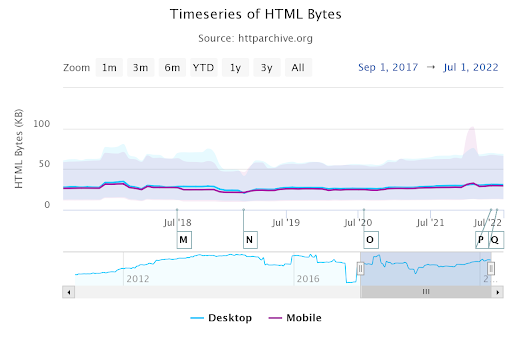 Screenshot from the creator, August 2022
Above, HTTPArchive.org exhibits the median desktop and cell HTML file measurement. Thus, most web sites would not have the issue of the 15 MB constraint for crawling.
However, the online is an enormous and chaotic place.
Understanding the character of the 15 MB crawling restrict and methods to research it is vital for SEOs.
A picture, video, or bug may cause crawling issues, and this lesser-known website positioning data will help tasks shield their natural search worth.
Is 15 MB Googlebot Crawling Restrict Solely For HTML Paperwork?
No.
15 MB Googlebot crawling restrict is for all indexable and crawlable paperwork, together with Google Earth, Hancom Hanword (.hwp), OpenOffice textual content (.odt), and Wealthy Textual content Format (.rtf), or different Googlebot-supported file varieties.
Are Picture And Video Sizes Summed With HTML Doc?
No, each useful resource is evaluated individually by the 15 MB crawling restrict.
If the HTML doc is 14.99 MB, and the featured picture of the HTML doc is 14.99 MB once more, they each will probably be crawled and utilized by Googlebot.
The HTML doc’s measurement is just not summed with the assets which might be linked by way of HTML tags.
Does Inlined CSS, JS, Or Information URI Bloat HTML Doc Dimension?
Sure, inlined CSS, JS, or the Information URI are counted and used within the HTML doc measurement.
Thus, if the doc exceeds 15 MB attributable to inlined assets and instructions, it can have an effect on the particular HTML doc’s crawlability.
Does Google Cease Crawling The Useful resource If It Is Larger Than 15 MB?
No, Google crawling methods don’t cease crawling the assets which might be greater than the 15 MB restrict.
They proceed to fetch the file and use solely the smaller half than the 15 MB.
For a picture greater than 15 MB, Googlebot can chunk the picture till the 15 MB with the assistance of “content material vary.”
The Content material-Vary is a response header that helps Googlebot or different crawlers and requesters carry out partial requests.
How To Audit The Useful resource Dimension Manually?
You should use Google Chrome Developer Instruments to audit the useful resource measurement manually.
Comply with the steps beneath on Google Chrome.
- Open an internet web page doc by way of Google Chrome.
- Press F12.
- Go to the Community tab.
- Refresh the online web page.
- Order the assets in line with the Waterfall.
- Test the measurement column on the primary row, which exhibits the HTML doc’s measurement.
Beneath, you possibly can see an instance of a searchenginejournal.com homepage HTML doc, which is greater than 77 KB.
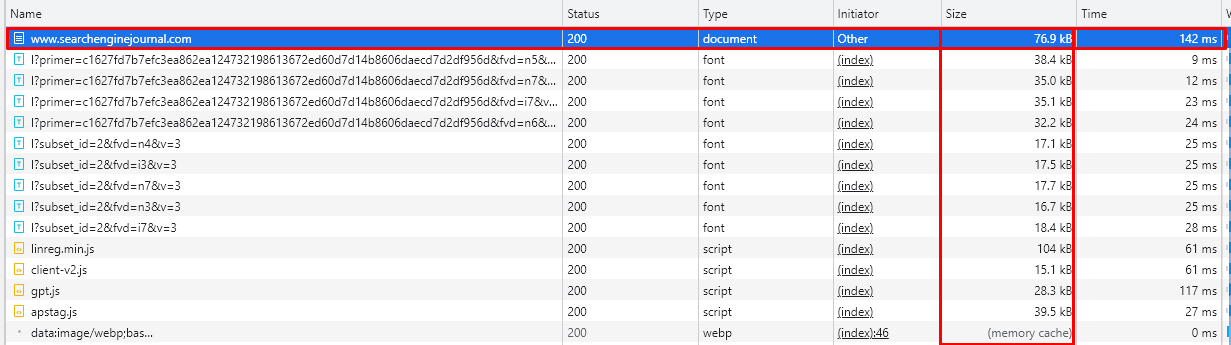 Screenshot by creator, August 2022
How To Audit The Useful resource Dimension Mechanically And Bulk?
Use Python to audit the HTML doc measurement robotically and in bulk. Advertools and Pandas are two helpful Python Libraries to automate and scale website positioning duties.
Comply with the directions beneath.
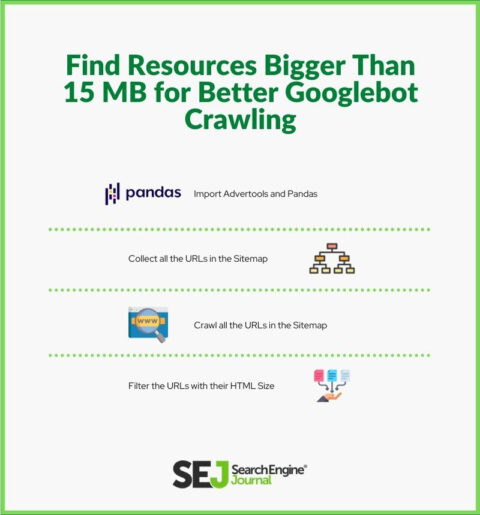
- Import Advertools and Pandas.
- Gather all of the URLs within the sitemap.
- Crawl all of the URLs within the sitemap.
- Filter the URLs with their HTML Dimension.
import advertools as adv

import pandas as pd

df = adv.sitemap_to_df("https://www.holisticseo.digital/sitemap.xml")

adv.crawl(df["loc"], output_file="output.jl", custom_settings={"LOG_FILE":"output_1.log"})

df = pd.read_json("output.jl", strains=True)

df[["url", "size"]].sort_values(by="measurement", ascending=False)
The code block above extracts the sitemap URLs and crawls them.
The final line of the code is just for creating an information body with a descending order primarily based on the sizes.
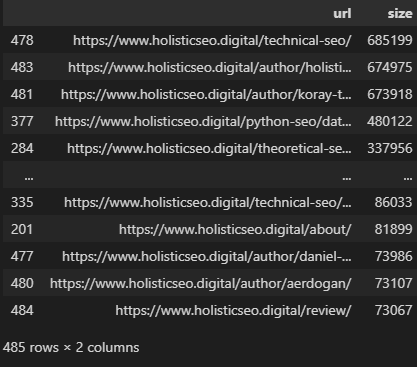 Picture created by creator, August 2022
You possibly can see the sizes of HTML paperwork as above.
The most important HTML doc on this instance is round 700 KB, which is a class web page.
So, this web site is protected for 15 MB constraints. However, we are able to test past this.
How To Test The Sizes of CSS And JS Assets?
Puppeteer is used to test the dimensions of CSS and JS Assets.
Puppeteer is a NodeJS package deal to regulate Google Chrome with headless mode for browser automation and web site exams.
Most website positioning execs use Lighthouse or Web page Pace Insights API for his or her efficiency exams. However, with the assistance of Puppeteer, each technical facet and simulation might be analyzed.
Comply with the code block beneath.
const puppeteer = require('puppeteer');

const XLSX = require("xlsx");

const path = require("path");


(async () => {

    const browser = await puppeteer.launch({

        headless: false

    });


    const web page = await browser.newPage();

    await web page.goto('https://www.holisticseo.digital');

    console.log('Web page loaded');

    const perfEntries = JSON.parse(

        await web page.consider(() => JSON.stringify(efficiency.getEntries()))

      );


      console.log(perfEntries);


      const workSheetColumnName = [

          "name",

          "transferSize",

          "encodedSize",

          "decodedSize"

          ]

          const urlObject = new URL("https://www.holisticseo.digital")

          const hostName = urlObject.hostname

          const domainName = hostName.exchange("www.|.com", "");

          console.log(hostName)

          console.log(domainName)

          const workSheetName = "Customers";

          const filePath = `./${domainName}`;

          const userList = perfEntries;


          const exportPerfToExcel = (userList) => {

              const knowledge = perfEntries.map(url => {

                  return [url.name, url.transferSize, url.encodedBodySize, url. decodedBodySize];

              })

              const workBook = XLSX.utils.book_new();

              const workSheetData = [

                  workSheetColumnName,

                  ...data

              ]

              const workSheet = XLSX.utils.aoa_to_sheet(workSheetData);

              XLSX.utils.book_append_sheet(workBook, workSheet, workSheetName);

              XLSX.writeFile(workBook, path.resolve(filePath));

              return true;


          }

          exportPerfToExcel(userList)


          //browser.shut();


})();
For those who have no idea JavaScript or didn’t end any form of Puppeteer tutorial, it could be somewhat more durable so that you can perceive these code blocks. However, it’s really easy.
It principally opens a URL, takes all of the assets, and provides their “transferSize”, “encodedSize”, and “decodedSize.”
On this instance, “decodedSize” is the dimensions that we have to give attention to. Beneath, you possibly can see the outcome within the type of an XLS file.
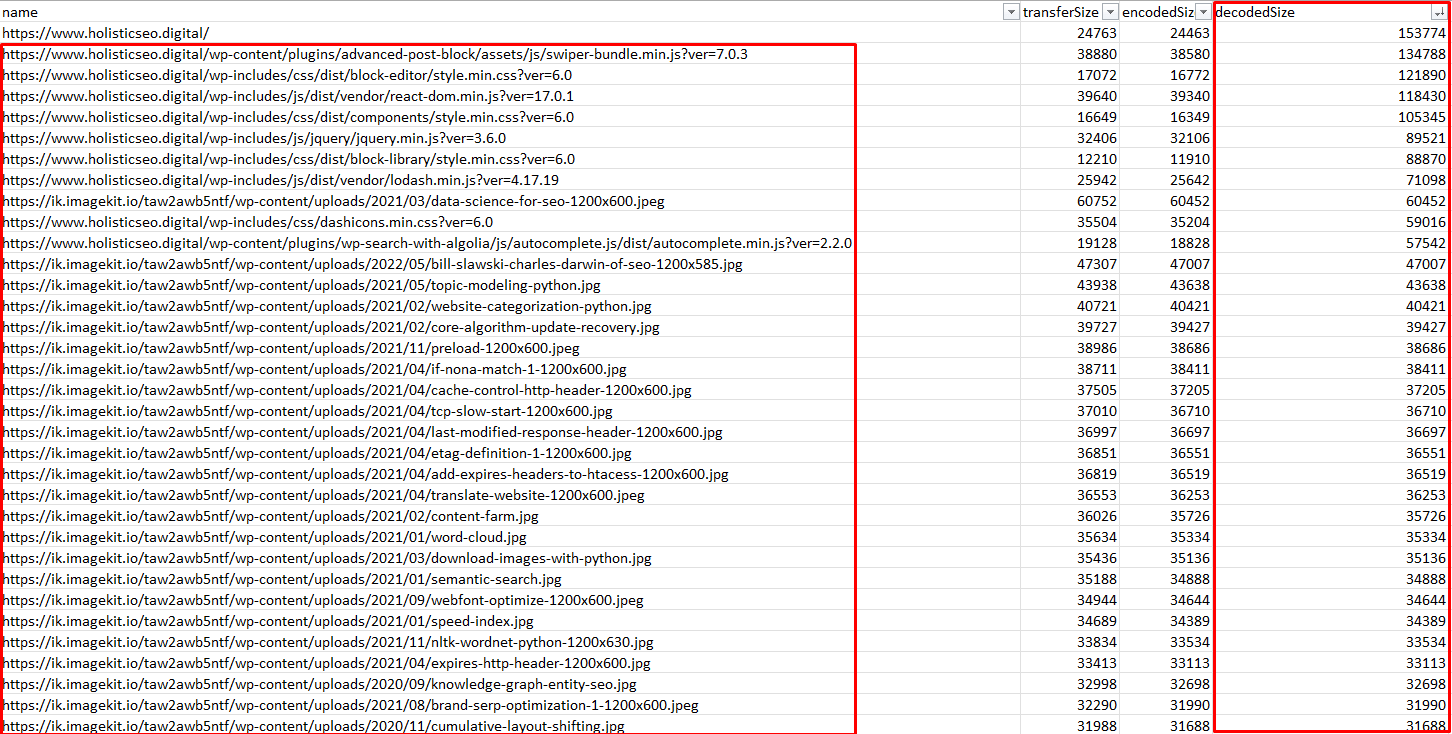 Byte sizes of the assets from the web site.
If you wish to automate these processes for each URL once more, you’ll need to make use of a for loop within the “await.web page.goto()” command.
In line with your preferences, you possibly can put each internet web page into a unique worksheet or connect it to the identical worksheet by appending it.
Conclusion
The 15 MB of Googlebot crawling constraint is a uncommon risk that can block your technical website positioning processes for now, however HTTPArchive.org exhibits that the median video, picture, and JavaScript sizes have elevated in the previous couple of years.
The median picture measurement on the desktop has exceeded 1 MB.
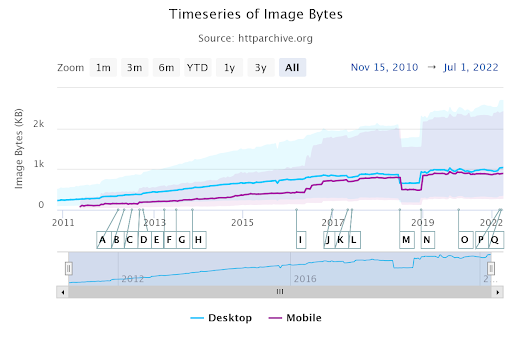 Screenshot by creator, August 2022
The video bytes exceed 5 MB in complete.
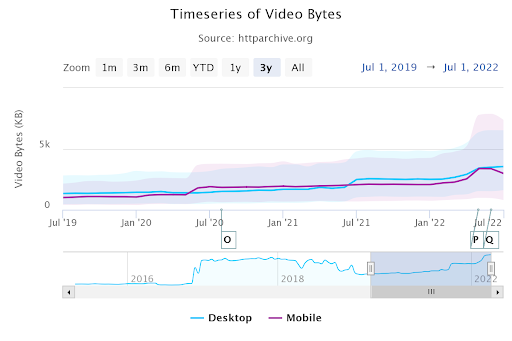 Screenshot by creator, August 2022
In different phrases, once in a while, these assets – or some elements of those assets – could be skipped by Googlebot.
Thus, it’s best to be capable of management them robotically, with bulk strategies to make time and never skip.
Extra assets:
Featured Picture: BestForBest/Shutterstock
[ad_2]

