


[ad_1]
Lately, the Division of Homeland Safety (DHS) recognized the necessity to encourage hands-on studying by way of cybersecurity competitions to deal with a scarcity of expert cyber defenders. Likewise, in 2019, Govt Order 13870 addressed the necessity to establish, problem, and reward the US authorities’s finest cybersecurity practitioners and groups throughout offensive and defensive cybersecurity disciplines. Nicely-developed cybersecurity competitions supply a means for presidency organizations to meet that order.
The Software program Engineering Institute (SEI) has been working with the DHS Cybersecurity & Infrastructure Safety Company (CISA) to convey distinctive cybersecurity challenges to the federal cyber workforce. This weblog submit highlights the SEI’s expertise growing cybersecurity challenges for the President’s Cup Cybersecurity Competitors and general-purpose pointers and finest practices for growing efficient challenges. It additionally discusses instruments the SEI has developed and made freely out there to help the event of cybersecurity challenges. The SEI technical report Problem Growth Pointers for Cybersecurity Competitions explores these concepts in larger element.
The Objective and Worth of Cybersecurity Challenges
Cybersecurity challenges are the guts of cybersecurity competitions. They supply the hands-on duties opponents carry out as a part of the competitors. Cybersecurity challenges can take a number of kinds and may contain totally different responses, reminiscent of performing actions on one or many digital machines (VM), analyzing varied varieties of information or information, or writing code. A single cybersecurity competitors would possibly comprise a number of totally different challenges.
The objective of those cybersecurity challenges is to show or assess cybersecurity abilities by way of hands-on workouts. Consequently, when constructing challenges, builders choose mission-critical work roles and duties from the Nationwide Initiative for Cybersecurity Training Workforce Framework for Cybersecurity (NICE Framework), a doc printed by the Nationwide Institute of Requirements in Expertise (NIST) and the Nationwide Initiative for Cybersecurity Careers and Research (NICCS). The NICE Framework defines 52 work roles and gives detailed details about the precise information, abilities, and talents (KSAs) required to carry out duties in every.
Utilizing the NICE Framework helps builders focus challenges on vital abilities that finest symbolize the cybersecurity workforce. Every problem clearly states which NICE work position and duties it targets. By figuring out the information and abilities every problem targets, opponents can simply concentrate on challenges that handle their strengths through the competitors and isolate studying alternatives when utilizing challenges for coaching.
Problem Planning
Creating profitable cybersecurity challenges begins with complete planning to find out the extent of issue for every problem, assessing the factors out there for every problem, and figuring out the instruments required to resolve the challenges. When it comes to issue, competitors organizers need individuals to really feel engaged and challenged. Challenges which are too simple will make extra superior individuals lose curiosity, and challenges which are too laborious will frustrate opponents. Competitions usually ought to embrace challenges which are appropriate for all ranges—newbie, intermediate, and superior.
Scoring
Factors techniques are used to reward opponents for the effort and time they spend fixing every problem. Furthermore, competitors organizers can use factors to find out competitor placement—opponents with larger scores can advance to future rounds, and organizers can acknowledge these with the best factors as winners. Factors ought to be commensurate with the issue posed by the problem and energy required to resolve it. Level allocation generally is a subjective course of, a matter we’ll return to within the part Problem Testing and Evaluation part beneath.
Problem Tooling
Figuring out the instruments required to resolve a problem is a crucial step within the improvement course of for 2 causes:
- It ensures that problem builders set up all required instruments within the problem atmosphere.
- It’s good follow to offer opponents an inventory instruments out there within the problem atmosphere, particularly for competitions through which organizers present opponents with the evaluation atmosphere.
Builders ought to be cautious to construct challenges that don’t require the usage of paid or licensed software program. Open supply or free instruments, purposes, and working techniques are very important as a result of some opponents won’t have entry to sure software program licenses, which might put them at a drawback and even forestall them from finishing altogether.
Problem Growth
Builders should be well-versed in cybersecurity material to plot revolutionary approaches to check opponents. Not solely should builders establish the abilities the problem will goal and the state of affairs it’s going to simulate, they need to additionally develop the technical facets of the problem, implement an automatic and auditable grading system, incorporate variability, and write documentation for each the testers and the opponents.
Pre-Growth Concerns
Builders ought to start by figuring out the work roles and abilities their problem goals to evaluate. By so doing, they’ll construct extra exact challenges and keep away from together with duties that don’t assess relevant abilities or that take a look at too vast an array of abilities. After they’ve outlined the work position related to a given problem, builders can type a problem thought.
The problem thought contains the technical duties opponents should full and the placement through which the problem state of affairs will happen. All problem duties ought to resemble the duties that professionals undertake as a part of their jobs. Builders are free to be as artistic as they need when constructing the state of affairs. Topical challenges based mostly on real-world cybersecurity occasions supply one other means so as to add distinctive and artistic eventualities to challenges.
Technical Element Concerns
The technical parts of problem improvement usually contain VM, community, and repair configuration. This configuration ensures the problem atmosphere deploys appropriately when opponents try the problem. Growth of technical parts would possibly embrace:
- Configuring VMs or companies to include recognized vulnerabilities
- Configuring routers, firewalls, companies, and many others., to the state builders need
- Staging assault artifacts or proof all through networks or logs
- Finishing different actions that put together the atmosphere for the problem
Builders may additionally purposefully misconfigure facets of the atmosphere if the problem targets figuring out and fixing misconfigurations.
Finest Practices for Growing Challenges
Every problem targets totally different abilities, so there is no such thing as a normal course of for growing a cybersecurity problem. Nevertheless, builders ought to apply the next finest practices:
- Make sure the technical abilities assessed by the problem are relevant in the true world.
- Make sure the instruments required to resolve the problem are free to make use of and out there to the opponents.
- Make an inventory of the instruments out there to opponents within the hosted atmosphere.
- Guarantee challenges don’t pressure opponents down a single answer path. Opponents ought to have the ability to remedy challenges in any life like method.
- Take away pointless hints or shortcuts from the problem, together with command historical past, shopping information, and different information that would enable opponents a shortcut to fixing the problem.
Problem Grading
Typically, builders ought to automate grading by way of an authoritative server that receives solutions from the opponents and determines what number of factors to award the submission. The submission system ought to usually ignore variations in capitalization, white house, particular characters, and different variations which are finally irrelevant to correctness. Doing so ensures opponents aren’t unfairly penalized for immaterial errors.
Ignoring these errors may appear to contradict an evaluation of operational readiness in circumstances the place actual precision is required. Nevertheless, cybersecurity competitions have targets and issues past evaluating operational proficiency, reminiscent of making certain a good competitors and inspiring broad participation.
Builders might apply totally different grading strategies, together with the next:
- Token discovery. In token-discovery grading, opponents should discover a string or token that follows an outlined format (these tokens may also be known as “flags”). Builders can place the token in any a part of the problem the place the competitor will discover it by finishing the problem duties.
- Query-and-answer issues. For question-and-answer issues, the competitor should discover the right reply to a number of questions by performing problem duties. The solutions to the problem questions can take a number of kinds, reminiscent of coming into file paths, IP addresses, hostnames, usernames, or different fields and codecs which are clearly outlined.
- Setting verification. In atmosphere verification grading, the system grades opponents based mostly on adjustments they make to the problem atmosphere. Challenges can activity opponents with fixing a misconfiguration, mitigating a vulnerability, attacking a service, or some other exercise the place success could be measured dynamically. When the grading system verifies adjustments to the atmosphere state, it gives opponents with a hit token.
Problem Variation
Builders ought to embrace some degree of variation between totally different deployments of a problem to permit for various appropriate solutions to the identical problem. Doing so is necessary for 2 causes. First, it helps promote a good competitors by discouraging opponents from sharing solutions. Second, it permits competitors organizers to reuse challenges with out dropping academic worth. Challenges that may be accomplished quite a few occasions with out leading to the identical reply allow opponents to study and hone their abilities by way of repeated follow of the identical problem.
Builders can introduce variation into challenges in a number of methods, relying on the kind of grading that they use:
- Token-based variation. Challenges utilizing token-discovery or environment-verification grading can randomly generate distinctive tokens for every competitor when the problem is deployed. Builders can insert dynamically generated submission tokens into the problem atmosphere (e.g., inserting guestinfo variables into VMs), they usually can copy them to the areas the place they anticipate opponents to obtain the problem solutions.
- Query-and-answer variation. In question-and-answer challenges, builders can introduce variation by configuring totally different solutions to the identical questions or by asking totally different questions.
Problem Documentation
The 2 key paperwork builders should create in help of their problem are the problem information and the answer information.
The problem information, which is seen to the opponents, gives a brief description of the problem, the abilities and duties the problem assesses, the state of affairs and any background data that’s required to grasp the atmosphere, machine credentials, and the submission space or areas.
The problem doc ought to describe the state of affairs in a means that opponents can simply comply with and perceive. The problem state of affairs and background data ought to keep away from logical leaps and the issue degree shouldn’t hinge on data internationally omitted of the information.
The answer information gives a walk-through of 1 method to full the problem. Throughout testing, builders use the answer information to make sure the problem could be solved. Builders also can launch the answer information to the general public after the conclusion of the competitors to function a group studying useful resource.
The meant viewers for this information is the overall cybersecurity group. Consequently, builders ought to assume the reader is acquainted with primary IT and cybersecurity abilities, however will not be an professional within the subject. Screenshots and different photographs are useful additions to those guides.
Problem Testing and Evaluation
After builders construct a problem, it ought to undergo a number of rounds of testing and assessment. Builders take a look at challenges to make sure high quality, they usually assessment them to estimate the problem’s issue.
Builders ought to carry out an preliminary spherical of testing to catch any errors that come up through the problem deployment and initialization course of. They need to additionally make sure that opponents can absolutely remedy the problem in at the least a method. A second spherical of testing ought to be performed by certified technical employees unfamiliar with the problem. Testers ought to be inspired to try fixing the problem on their very own however could also be supplied the developer’s answer information for assist.
The testers ought to guarantee every problem meets the next high quality assurance standards:
- The problem deploys as anticipated and with out errors.
- The problem VMs are accessible.
- The problem is solvable.
- There aren’t any unintentional shortcuts to fixing the problem.
- Problem directions and questions are correctly formatted and provides a transparent indication of what opponents should do.
Of their assessment of the problem, testers ought to take notes in regards to the content material, together with estimates of issue and size of time it might take opponents to resolve. After testers full their assessment, competitors organizers can study the issue assessments and examine every problem with others. This comparability ensures that simpler challenges stay in earlier rounds and are value fewer factors than challenges judged as harder.
When deciding problem level allocations, organizers can use a base or normal rating allotment as a place to begin (e.g., all challenges are value 1,000 factors initially of the method). Organizers can then improve or lower level allocations based mostly on the out there issue information, preserving in thoughts that the primary objective is for the variety of factors they allocate to a problem to instantly correspond with the hassle required for fixing it. Level allocations ought to take into account each the issue and the time it takes to resolve the problem.
SEI Open Supply Purposes for Cybersecurity Problem Competitions
Builders can use a number of open supply purposes to develop challenges and to orchestrate cybersecurity competitions. The SEI has developed the next two purposes for working cybersecurity competitions:
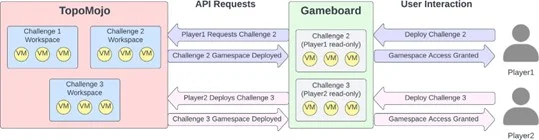
- TopoMojo is an open supply lab builder and participant utility that builders can use to develop cybersecurity challenges. It gives digital workspaces through which problem improvement can happen. The workspaces enable builders so as to add VMs, digital networks, and some other assets which are required for growing or fixing a single problem.
- Gameboard is an open supply utility that organizers can use for orchestrating cybersecurity competitions. It allows organizers to create competitions that may both be crew or particular person based mostly and that include both single or a number of rounds. Challenges are organized into rounds and opponents try to resolve as many challenges as they’ll to maximise their rating. Gameboard makes use of the TopoMojo API to deploy the opponents’ recreation house for every problem.
Gameboard additionally serves because the authoritative location for opponents to submit solutions or tokens. Furthermore, as a part of dealing with reply and token submissions, Gameboard has logging, brute pressure protections, and different options to make sure the integrity of the competitors.
Determine 1 exhibits how the TopoMojo and Gameboard purposes work together. Builders use TopoMojo workspaces to develop challenges. Opponents then use Gameboard to deploy and in- teract with challenges. When a participant deploys a problem, Gameboard will work together with the To- poMojo API to request a brand new recreation house for the competitor. TopoMojo creates and returns the participant’s problem recreation house.
Finest Practices Help Higher Cybersecurity Competitions
The event practices now we have highlighted on this submit are the results of the SEI’s expertise growing cybersecurity challenges for the President’s Cup Cybersecurity Competitors. Cybersecurity competitions present a enjoyable and fascinating method to train technical abilities, establish and acknowledge cybersecurity expertise, and have interaction college students and professionals within the subject. They will additionally function schooling and coaching alternatives. With the US authorities, and the nation as an entire, dealing with a major scarcity within the cybersecurity workforce, cybersecurity competitions play an necessary position in growing and increasing the workforce pipeline.
There isn’t any single method to run a contest, and there’s no one method to develop cybersecurity challenges. Nevertheless, these finest practices may also help builders make sure the challenges they create are efficient and interesting. Problem improvement is the only most necessary and time-consuming facet of working a cybersecurity competitors. It requires meticulous planning, technical improvement, and a rigorous quality-assurance course of. In our expertise, these practices guarantee efficiently executed competitions and enduring, hands-on cybersecurity property that competitors organizers and others can reuse many occasions over.
If you need to study extra in regards to the work we do to strengthen the cybersecurity workforce and the instruments now we have developed to help this mission, contact us at information@sei.cmu.edu.
[ad_2]

