



[ad_1]
Can’t wait on your new content material to get listed?
Be taught why it’s so onerous to estimate how lengthy indexing could take and what you are able to do to hurry issues up.
Indexing is the method of downloading data out of your web site, categorizing it, and storing it in a database. This database – the Google index – is the supply of all data you could find by way of Google Search.
Pages that aren’t included within the index can’t seem in search outcomes, regardless of how nicely they match a given question.
Let’s assume you’ve not too long ago added a brand new web page to your weblog. In your new submit, you talk about a trending matter, hoping it should give you a number of new site visitors.
However earlier than you may see how the web page is doing on Google Search, you need to look forward to it to be listed.
So, how lengthy precisely does this course of take? And when do you have to begin worrying that the shortage of indexing could sign technical issues in your website?
Let’s examine!
How Lengthy Does Indexing Take? Specialists’ Greatest Guesses
The Google index accommodates a whole bunch of billions of net pages and takes up over 100 million gigabytes of reminiscence.
Moreover, Google doesn’t restrict what number of pages on an internet site could be listed. Whereas some pages could have precedence within the indexing queue, pages typically don’t need to compete for indexing.
There ought to nonetheless be room for yet one more small web page on this colossal database, proper? There’s no want to fret about your weblog entry? Sadly, you might need to.
Google admits that not each web page processed by its crawlers can be listed.
In January 2021, Google Search Advocate, John Mueller, elaborated on the subject, disclosing that it’s fairly regular that Google doesn’t index all of the pages of a big web site.
He defined that the problem for Google is attempting to stability desirous to index as a lot content material as doable with estimating if will probably be helpful for search engine customers.
Subsequently, in lots of circumstances, not indexing a given piece of content material is Google’s strategic alternative.
Google doesn’t need its index to incorporate pages of low high quality, duplicate content material, or pages unlikely to be seemed for by customers. The easiest way to maintain spam out of search outcomes is to not index it.
However so long as you retain your weblog posts helpful and helpful, they’re nonetheless getting listed, proper?
The reply is difficult.
Tomek Rudzki, an indexing skilled at Onely – an organization I work for – calculated that, on common, 16% of helpful and indexable pages on common web sites by no means get listed.
Is There A Assure That Your Web page Will Be Listed?
As you’ll have already guessed from the title of this text, there isn’t a definitive reply to this indexing query.
You received’t be capable of set your self a calendar reminder on the day your weblog submit is because of be listed.
However many individuals have requested the identical query earlier than, urging Googlers and skilled search engine optimization professionals to offer some hints.
John Mueller says it could possibly take wherever from a number of hours to a number of weeks for a web page to be listed. He suspects that almost all good content material is picked up and listed inside a few week.
Analysis carried out by Rudzki confirmed that, on common, 83% of pages are listed throughout the first week of publication.
Some pages have to attend as much as eight weeks to get listed. After all, this solely applies to pages that do get listed ultimately.
Crawl Demand And Crawl Price range
For a brand new web page in your weblog to be found and listed, Googlebot has to recrawl the weblog.
How typically Googlebot recrawls your web site actually impacts how rapidly your new web page will get listed, and that will depend on the character of the content material and the frequency with which it will get up to date.
Information web sites that publish new content material extraordinarily typically must be recrawled steadily. We are able to say they’re websites with excessive crawl demand.
An instance of a low crawl demand website can be a website concerning the historical past of blacksmithing, as its content material is unlikely to be up to date very steadily.
Google routinely determines whether or not the location has a low or excessive crawl demand. Throughout preliminary crawling, it checks what the web site is about and when it was final up to date.
The choice to crawl the location roughly typically has nothing to do with the standard of the content material – the decisive issue is the estimated frequency of updates.
The second essential issue is the crawl fee. It’s the variety of requests Googlebot could make with out overwhelming your server.
When you host your weblog on a low-bandwidth server and Googlebot notices that the server is slowing down, it’ll alter and cut back the crawl fee.
However, if the location responds rapidly, the restrict goes up, and Googlebot can crawl extra URLs.
What Wants To Occur Earlier than Your Web page Is Listed?
Since indexing takes time, one may also surprise – how precisely is that point spent?
How is the data out of your web site categorized and included within the Google index?
Let’s talk about the occasions that should occur earlier than the indexing.
Content material Discovery
Let’s return to the instance during which you posted a brand new weblog entry. Googlebot wants to find this web page’s URL in step one of the indexing pipeline.
It might probably occur by:
- Following inner hyperlinks you offered on different pages of your weblog.
- Following exterior hyperlinks created by individuals who discovered your new content material helpful.
- Going by way of an XML sitemap that you just uploaded to Google Search Console.
The truth that the web page has been found implies that Google is aware of about its existence and URL.
Crawling
Crawling is the method of visiting the URL and fetching the web page’s contents.
Whereas crawling, Googlebot collects details about a given web page’s important matter, what information this web page accommodates, what key phrases seem on it, and many others.
After discovering hyperlinks on a web page, the crawler follows them to the following web page, and the cycle continues.
It’s essential to do not forget that Googlebot follows the principles arrange by robots.txt in order that it received’t crawl pages blocked by the directives you present in that file.
Rendering
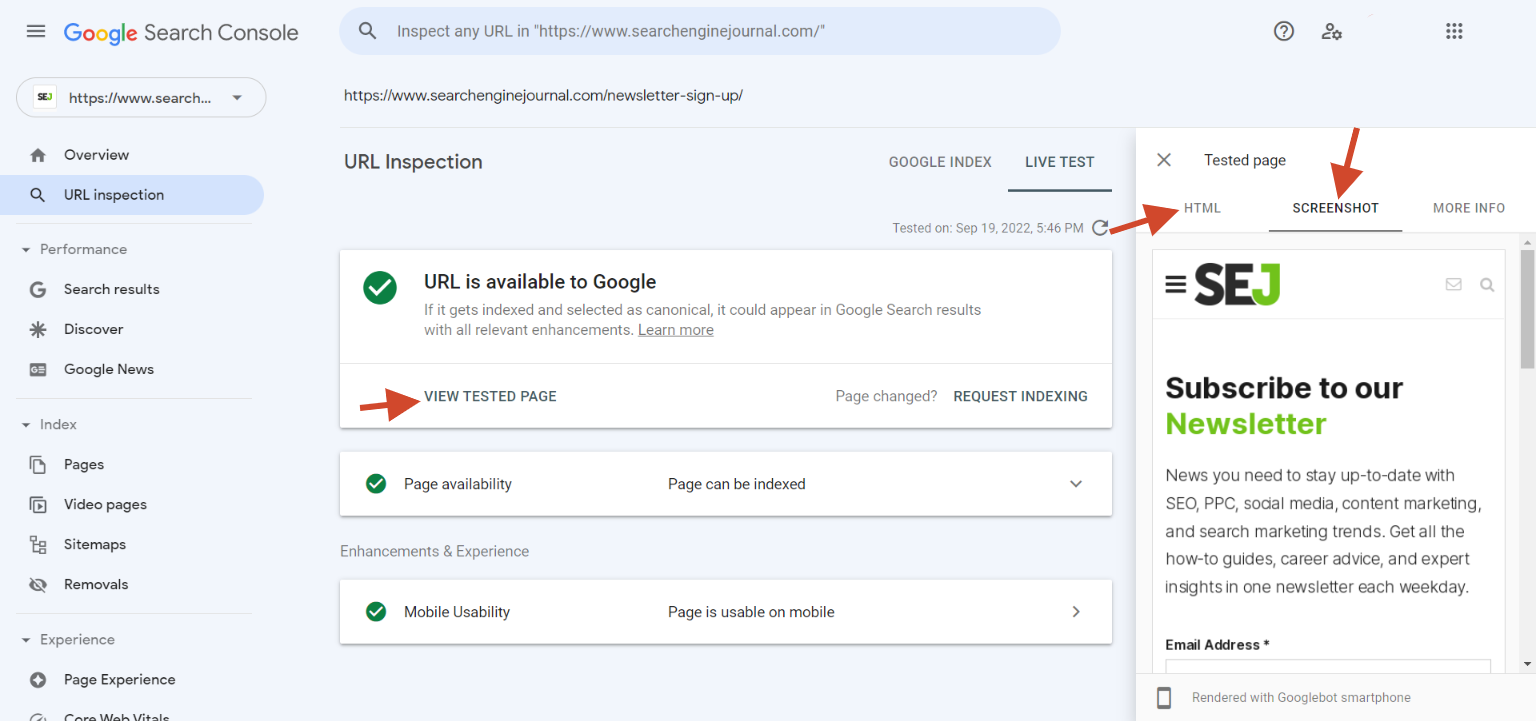 Screenshot from Google Search Console, September 2022
The rendering must occur for Googlebot to grasp each the JavaScript content material and pictures, audio, and video information.
Some of these information at all times had been a much bigger wrestle for Google than HTML.
Google’s developer advocate, Martin Splitt, in contrast rendering to cooking a dish.
On this metaphor, the preliminary HTML file of an internet site with hyperlinks to different contents is a recipe. You’ll be able to press F12 in your keyboard to view it in your browser.
All the web site’s sources, resembling CSS, JavaScript information, photographs, and movies, are the substances vital to present the web site its last look.
When the web site achieves this state, you’re coping with the rendered HTML, extra typically known as Doc Object Mannequin.
Martin additionally mentioned that executing JavaScript is the very first rendering stage as a result of JavaScript works like a recipe inside a recipe.
Within the not-too-distant previous, Googlebot used to index the preliminary HTML model of a web page and depart JavaScript rendering for late as a result of value and time-consuming nature of the method.
The search engine optimization business referred to that phenomenon as “the 2 waves of indexing.”
Nevertheless, now plainly the 2 waves are now not vital.
Mueller and Splitt admitted that, these days, almost each new web site goes by way of the rendering stage by default.
One in all Google’s targets is getting crawling, rendering, and indexing to occur nearer collectively.
Can You Get Your Web page Listed Sooner?
You’ll be able to’t power Google to index your new web page.
How rapidly this occurs can also be past your management. Nevertheless, you may optimize your pages in order that discovering and crawling run as easily as doable.
Right here’s what you have to do:
Make Certain Your Web page Is Indexable
There are two essential guidelines to comply with to maintain your pages indexable:
- You need to keep away from blocking them by robots.txt or the noindex directive.
- You need to mark the canonical model of a given content material piece with a canonical tag.
Robots.txt is a file containing directions for robots visiting your website.
You should use it to specify which crawlers will not be allowed to go to sure pages or folders. All you need to do is use the disallow directive.
For instance, for those who don’t need robots to go to pages and information within the folder titled “instance,” your robots.txt file ought to include the next directives:
Consumer-agent: *

Disallow: /instance/
Typically, it’s doable to dam Googlebot from indexing helpful pages by mistake.
In case you are involved that your web page isn’t listed because of technical issues, you need to positively check out your robots.txt.
Googlebot is well mannered and received’t move any web page it was informed to not to the indexing pipeline. A strategy to specific such a command is to place a noindex directive in:
Guarantee that this directive doesn’t seem on pages that needs to be listed.
As we mentioned, Google desires to keep away from indexing duplicate content material. If it finds two pages that appear to be copies of one another, it should doubtless solely index one in every of them.
The canonical tag was created to keep away from misunderstandings and instantly direct Googlebot to the URL that the web site proprietor considers the unique model of the web page.
Do not forget that the supply code of a web page you need to be current within the Google index shouldn’t level to a different web page as canonical.
Submit A Sitemap
A sitemap lists your web site’s each URL that you just want to get listed (as much as 50,000).
You’ll be able to submit it to Google Search Console to assist Google uncover the sitemap extra rapidly.
With a sitemap, you make it simpler for Googlebot to find your pages and improve the possibility it’ll crawl these it didn’t discover whereas following inner hyperlinks.
It’s a great observe to reference the sitemap in your robots.txt file.
Ask Google To Recrawl Your Pages
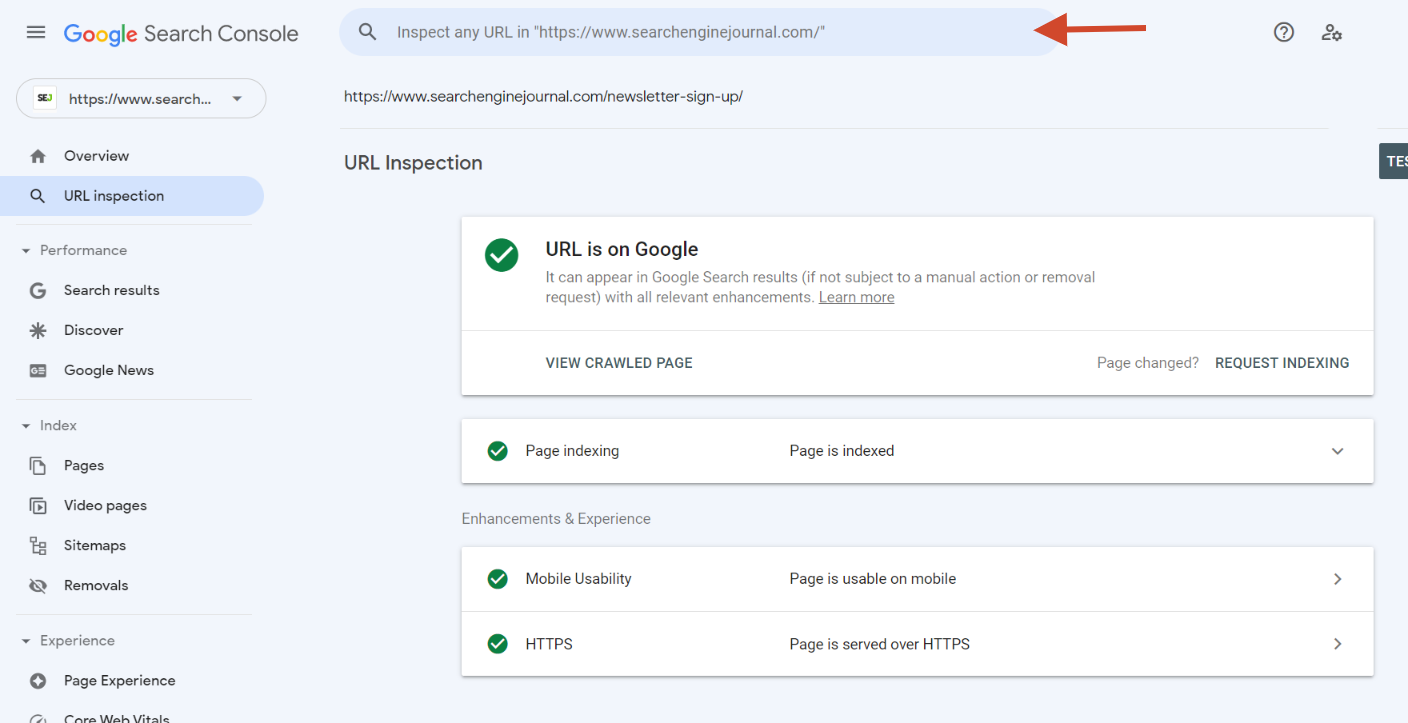 Screenshot from Google Search Console, September 2022
You’ll be able to request a crawl of particular person URLs utilizing the URL Inspection software accessible in Google Search Console.
It nonetheless received’t assure indexing, and also you’ll want some persistence, however it’s one other manner to ensure Google is aware of your web page exists.
If Related, Use Google’s Indexing API
Indexing API is a software permitting you to inform Google about freshly added pages.
Due to this software, Google can schedule the indexing of time-sensitive content material extra effectively.
Sadly, you may’t use it on your weblog posts as a result of, at the moment, this software is meant just for pages with job provides and reside movies.
Whereas some search engine optimization professionals use the Indexing API for different forms of pages – and it’d work short-term – it’s uncertain to stay a viable answer in the long term.
Forestall The Server Overload On Your Web site
Lastly, keep in mind to make sure good bandwidth of your server in order that Googlebot doesn’t cut back the crawl fee on your web site.
Keep away from utilizing shared internet hosting suppliers, and keep in mind to recurrently stress-test your server to ensure it could possibly deal with the job.
Abstract
It’s inconceivable to exactly predict how lengthy it should take on your web page to be listed (or whether or not it should ever occur) as a result of Google doesn’t index all of the content material it processes.
Usually indexing happens hours to weeks after publication.
The most important bottleneck for getting listed is getting promptly crawled.
In case your content material meets the standard thresholds and there aren’t any technical obstacles for indexing, you need to primarily take a look at how Googlebot crawls your website to get contemporary content material listed rapidly.
Earlier than a web page is redirected to the indexing pipeline, Googlebot crawls it and, in lots of circumstances, renders embed photographs, movies, and JavaScript components.
Web sites that change extra typically and, due to this fact, have a better crawl demand are recrawled extra typically.
When Googlebot visits your web site, it should match the crawl fee primarily based on the variety of queries it could possibly ship to your server with out overloading it.
Subsequently, it’s value caring for good server bandwidth.
Don’t block Googlebot in robots.txt as a result of then it received’t crawl your pages.
Do not forget that Google additionally respects the noindex robots meta tag and usually indexes solely the canonical model of the URL.
Extra sources:
Featured Picture: Kristo-Gothard Hunor/Shutterstock
[ad_2]

