



[ad_1]
Vocabulary measurement and distinction are semantic and linguistic ideas for mathematical and qualitative linguistics.
For instance, Heaps’ legislation claims that the size of the article and vocabulary measurement are correlative. Nonetheless, after a sure threshold, the identical phrases proceed to seem with out enhancing vocabulary measurement.
The Word2Vec makes use of Steady Bag of Phrases (CBOW) and Skip-gram to know the domestically contextually related phrases and their distance to one another. On the identical time, GloVe tries to make use of matrix factorization with context home windows.
Zipf’s legislation is a complementary idea to Heaps’ legislation. It states that essentially the most frequent and second most frequent phrases have a daily proportion distinction between them.
There are different distributional semantics and linguistic theories in statistical pure language processing.
However “vocabulary comparability” is a elementary methodology for serps to know “topicality variations,” “the primary matter of the doc,” or total “experience of the doc.”
Paul Haahr of Google said that it compares the “question vocabulary” to the “doc vocabulary.”
David C. Taylor and his designs for context domains contain sure phrase vectors in vector search to see which doc and which doc subsection are extra about what, so a search engine can rank and rerank paperwork based mostly on search question modifications.
Evaluating vocabulary variations between rating net pages on the search engine outcomes web page (SERP) helps search engine marketing professionals see what contexts, concurrent phrases, and phrase proximity they’re skipping in comparison with their rivals.
It’s useful to see context variations within the paperwork.
On this information, the Python programming language is used to go looking on Google and take SERP objects (snippets) to crawl their content material, tokenize and examine their vocabulary to one another.
How To Examine Rating Internet Paperwork’ Vocabulary With Python?
To check the vocabularies of rating net paperwork (with Python), the used libraries and packages of Python programming language are listed under.
- Googlesearch is a Python bundle for performing a Google search with a question, area, language, variety of outcomes, request frequency, or secure search filters.
- URLlib is a Python library for parsing the URLs to the netloc, scheme, or path.
- Requests (non-obligatory) are to take the titles, descriptions, and hyperlinks on the SERP objects (snippets).
- Fake_useragent is a Python bundle to make use of faux and random consumer brokers to forestall 429 standing codes.
- Advertools is used to crawl the URLs on the Google question search outcomes to take their physique textual content for textual content cleansing and processing.
- Pandas regulate and combination the information for additional evaluation of the distributional semantics of paperwork on the SERP.
- Pure LanguageTool equipment is used to tokenize the content material of the paperwork and use English cease phrases for cease phrase elimination.
- Collections to make use of the “Counter” methodology for counting the incidence of the phrases.
- The string is a Python module that calls all punctuation in a listing for punctuation character cleansing.
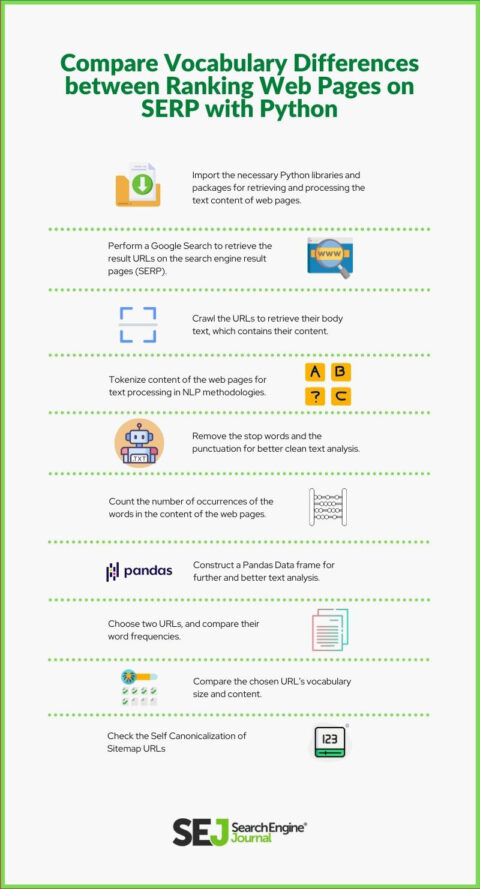
What Are The Steps For Comparability Of Vocabulary Sizes, And Content material Between Internet Pages?
The steps for evaluating the vocabulary measurement and content material between rating net pages are listed under.
- Import the mandatory Python libraries and packages for retrieving and processing the textual content content material of net pages.
- Carry out a Google search to retrieve the consequence URLs on the SERP.
- Crawl the URLs to retrieve their physique textual content, which comprises their content material.
- Tokenize content material of the net pages for textual content processing in NLP methodologies.
- Take away the cease phrases and the punctuation for higher clear textual content evaluation.
- Depend the variety of phrases occurrences within the net web page’s content material.
- Assemble a Pandas Information body for additional and higher textual content evaluation.
- Select two URLs, and examine their phrase frequencies.
- Examine the chosen URL’s vocabulary measurement and content material.
1. Import The Needed Python Libraries And Packages For Retrieving And Processing The Textual content Content material Of Internet Pages
Import the mandatory Python libraries and packages through the use of the “from” and “import” instructions and strategies.
from googlesearch import search

from urllib.parse import urlparse

import requests

from fake_useragent import UserAgent

import advertools as adv

import pandas as pd

from nltk.tokenize import word_tokenize

import nltk

from collections import Counter

from nltk.corpus import stopwords

import string

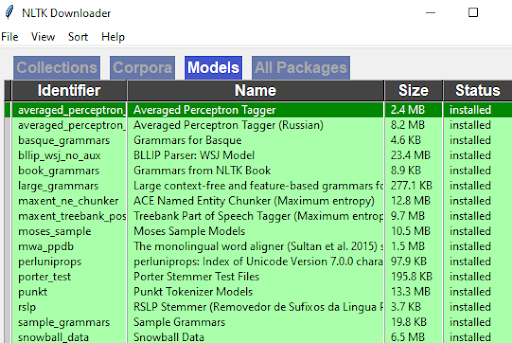
nltk.obtain()
Use the “nltk.obtain” provided that you’re utilizing NLTK for the primary time. Obtain all of the corpora, fashions, and packages. It’ll open a window as under.
 Screenshot from creator, August 2022
Refresh the window infrequently; if the whole lot is inexperienced, shut the window in order that the code working in your code editor stops and completes.
For those who would not have some modules above, use the “pip set up” methodology for downloading them to your native machine. When you’ve got a closed-environment undertaking, use a digital surroundings in Python.
2. Carry out A Google Search To Retrieve The End result URLs On The Search Engine End result Pages
To carry out a Google search to retrieve the consequence URLs on the SERP objects, use a for loop within the “search” object, which comes from “Googlesearch” bundle.
serp_item_url = []

for i in search("SEO", num=10, begin=1, cease=10, pause=1, lang="en", nation="us"):

    serp_item_url.append(i)

    print(i)
The reason of the code block above is:
- Create an empty record object, comparable to “serp_item_url.”
- Begin a for loop throughout the “search” object that states a question, language, variety of outcomes, first and final consequence, and nation restriction.
- Append all the outcomes to the “serp_item_url” object, which entails a Python record.
- Print all of the URLs that you’ve got retrieved from Google SERP.
You may see the consequence under.
The rating URLs for the question “SEO” is given above.
The subsequent step is parsing these URLs for additional cleansing.
As a result of if the outcomes contain “video content material,” it received’t be potential to carry out a wholesome textual content evaluation if they don’t have a protracted video description or too many feedback, which is a unique content material kind.
3. Clear The Video Content material URLs From The End result Internet Pages
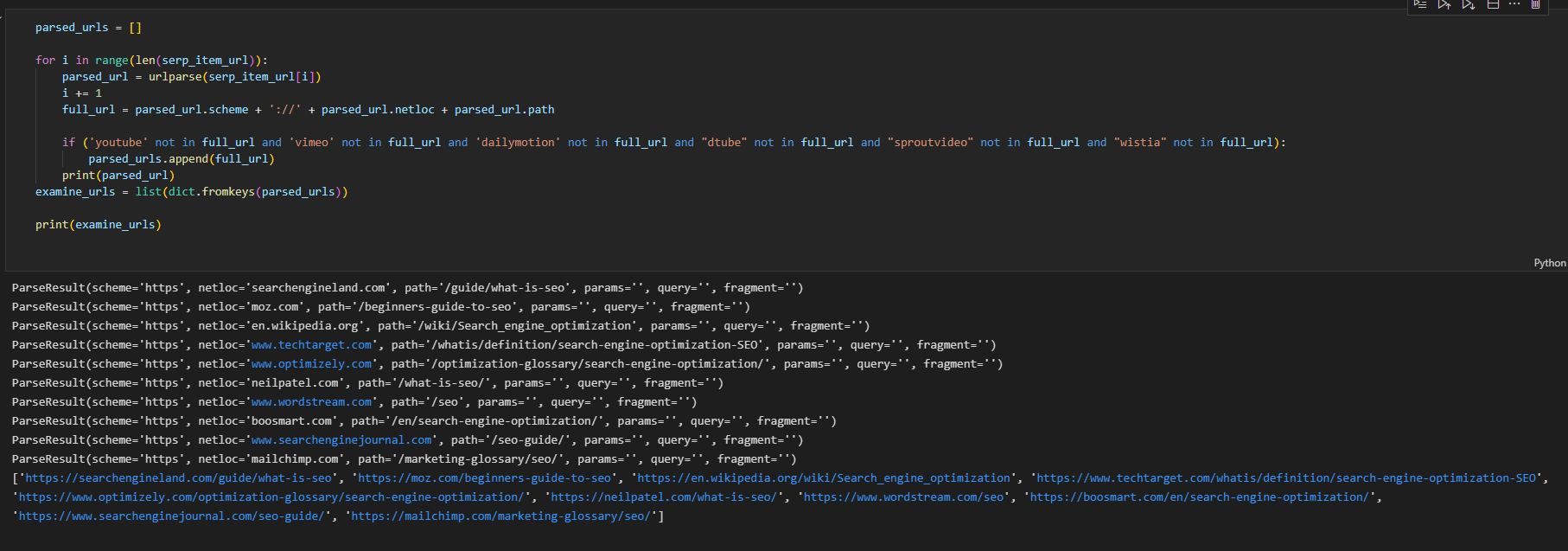
To wash the video content material URLs, use the code block under.
parsed_urls = []


for i in vary(len(serp_item_url)):

    parsed_url = urlparse(serp_item_url[i])

    i += 1

    full_url = parsed_url.scheme + '://' + parsed_url.netloc + parsed_url.path


    if ('youtube' not in full_url and 'vimeo' not in full_url and 'dailymotion' not in full_url and "dtube" not in full_url and "sproutvideo" not in full_url and "wistia" not in full_url):

        parsed_urls.append(full_url)
The video serps comparable to YouTube, Vimeo, Dailymotion, Sproutvideo, Dtube, and Wistia are cleaned from the ensuing URLs if they seem within the outcomes.
You should use the identical cleansing methodology for the web sites that you just assume will dilute the effectivity of your evaluation or break the outcomes with their very own content material kind.
For instance, Pinterest or different visual-heavy web sites won’t be essential to test the “vocabulary measurement” variations between competing paperwork.
Clarification of code block above:
- Create an object comparable to “parsed_urls.”
- Create a for loop within the vary of size of the retrieved consequence URL depend.
- Parse the URLs with “urlparse” from “URLlib.”
- Iterate by rising the depend of “i.”
- Retrieve the complete URL by uniting the “scheme”, “netloc”, and “path.”
- Carry out a search with situations within the “if” assertion with “and” situations for the domains to be cleaned.
- Take them into a listing with “dict.fromkeys” methodology.
- Print the URLs to be examined.
You may see the consequence under.
 Screenshot from creator, August 2022
4. Crawl The Cleaned Study URLs For Retrieving Their Content material
Crawl the cleaned study URLs for retrieving their content material with advertools.
You may also use requests with a for loop and record append methodology, however advertools is quicker for crawling and creating the information body with the ensuing output.
With requests, you manually retrieve and unite all of the “p” and “heading” parts.
adv.crawl(examine_urls, output_file="examine_urls.jl",

          follow_links=False,

          custom_settings={"USER_AGENT": UserAgent().random,

                           "LOG_FILE": "examine_urls.log",

                           "CRAWL_DELAY": 2})

crawled_df = pd.read_json("examine_urls.jl", strains=True)

crawled_df
Clarification of code block above:
- Use “adv.crawl” for crawling the “examine_urls” object.
- Create a path for output recordsdata with “jl” extension, which is smaller than others.
- Use “follow_links=false” to cease crawling just for listed URLs.
- Use customized settings to state a “random consumer agent” and a crawl log file if some URLs don’t reply the crawl requests. Use a crawl delay configuration to forestall 429 standing code risk.
- Use pandas “read_json” with the “strains=True” parameter to learn the outcomes.
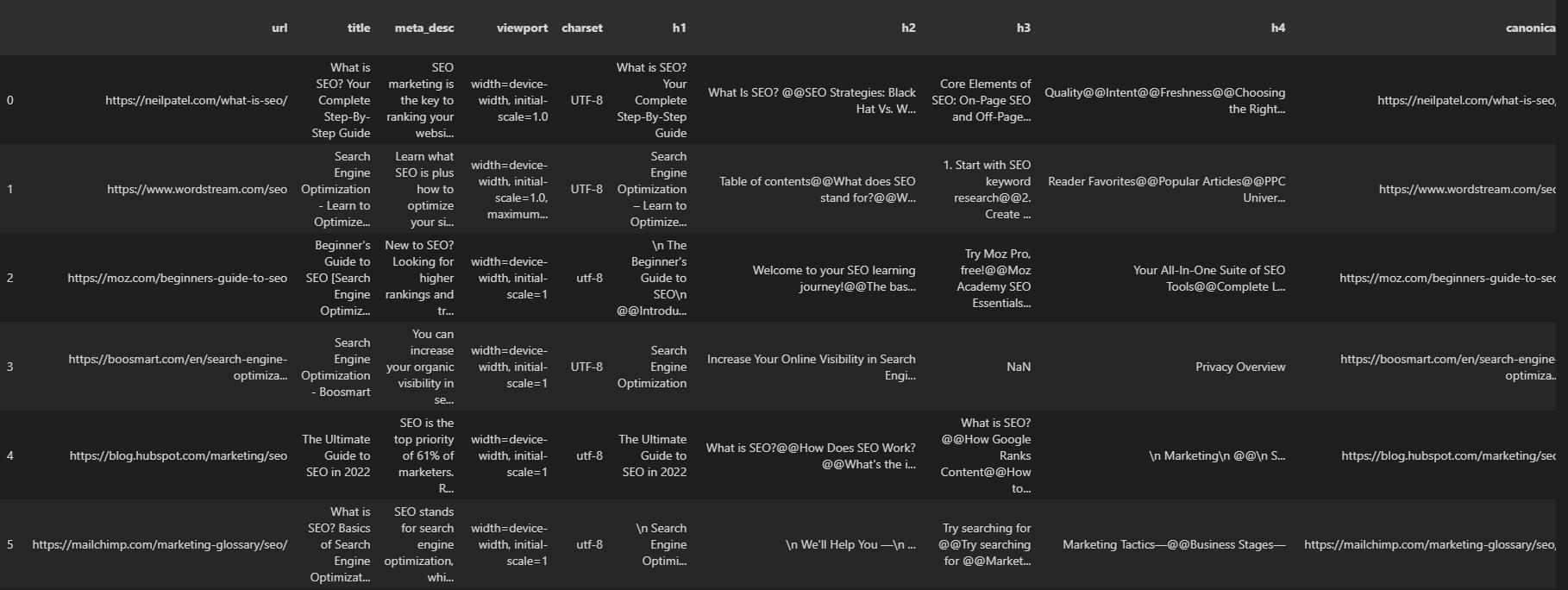
- Name the “crawled_df” as under.
You may see the consequence under.
 Screenshot from creator, August 2022
You may see our consequence URLs and all their on-page search engine marketing parts, together with response headers, response sizes, and structured knowledge data.
5. Tokenize The Content material Of The Internet Pages For Textual content Processing In NLP Methodologies
Tokenization of the content material of the net pages requires selecting the “body_text” column of advertools crawl output and utilizing the “word_tokenize” from NLTK.
crawled_df["body_text"][0]The code line above calls your entire content material of one of many consequence pages as under.
 Screenshot from creator, August 2022
To tokenize these sentences, use the code block under.
tokenized_words = word_tokenize(crawled_df["body_text"][0])

len(tokenized_words)
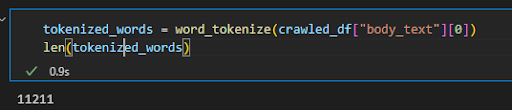
We tokenized the content material of the primary doc and checked what number of phrases it had.
 Screenshot from creator, August 2022
The primary doc we tokenized for the question “SEO” has 11211 phrases. And boilerplate content material is included on this quantity.
6. Take away The Punctuations And Cease Phrases From Corpus
Take away the punctuations, and the cease phrases, as under.
stop_words = set(stopwords.phrases("english"))
tokenized_words = [word for word in tokenized_words if not word.lower() in stop_words and word.lower() not in string.punctuation]

len(tokenized_words)
Clarification of code block above:
- Create a set with the “stopwords.phrases(“english”)” to incorporate all of the cease phrases within the English language. Python units don’t embody duplicate values; thus, we used a set fairly than a listing to forestall any battle.
- Use record comprehension with “if” and “else” statements.
- Use the “decrease” methodology to check the “And” or “To” varieties of phrases correctly to their lowercase variations within the cease phrases record.
- Use the “string” module and embody “punctuations.” A notice right here is that the string module won’t embody all of the punctuations that you just would possibly want. For these conditions, create your individual punctuation record and change these characters with house utilizing the regex, and “regex.sub.”
- Optionally, to take away the punctuations or another non-alphabetic and numeric values, you need to use the “isalnum” methodology of Python strings. However, based mostly on the phrases, it’d give totally different outcomes. For instance, “isalnum” would take away a phrase comparable to “keyword-related” because the “-” on the center of the phrase isn’t alphanumeric. However, string.punctuation wouldn’t take away it since “keyword-related” isn’t punctuation, even when the “-” is.
- Measure the size of the brand new record.
The brand new size of our tokenized thesaurus is “5319”. It reveals that almost half of the vocabulary of the doc consists of cease phrases or punctuations.
It’d imply that solely 54% of the phrases are contextual, and the remaining is useful.
7. Depend The Quantity Of Occurrences Of The Phrases In The Content material Of The Internet Pages
To depend the occurrences of the phrases from the corpus, the “Counter” object from the “Collections” module is used as under.
counted_tokenized_words = Counter(tokenized_words)

counts_of_words_df = pd.DataFrame.from_dict(

    counted_tokenized_words, orient="index").reset_index()

counts_of_words_df.sort_values(by=0, ascending=False, inplace=True)

counts_of_words_df.head(50)
An evidence of the code block is under.
- Create a variable comparable to “counted_tokenized_words” to contain the Counter methodology outcomes.
- Use the “DataFrame” constructor from the Pandas to assemble a brand new knowledge body from Counter methodology outcomes for the tokenized and cleaned textual content.
- Use the “from_dict” methodology as a result of “Counter” offers a dictionary object.
- Use “sort_values” with “by=0” which implies kind based mostly on the rows, and “ascending=False” means to place the very best worth to the highest. “Inpace=True” is for making the brand new sorted model everlasting.
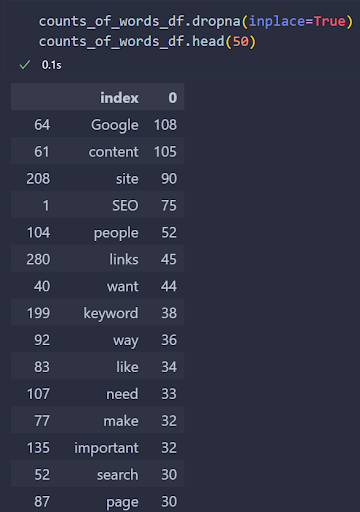
- Name the primary 50 rows with the “head()” methodology of pandas to test the primary look of the information body.
You may see the consequence under.
 Screenshot from creator, August 2022
We don’t see a cease phrase on the outcomes, however some attention-grabbing punctuation marks stay.
That occurs as a result of some web sites use totally different characters for a similar functions, comparable to curly quotes (sensible quotes), straight single quotes, and double straight quotes.
And string module’s “features” module doesn’t contain these.
Thus, to scrub our knowledge body, we are going to use a customized lambda perform as under.
removed_curly_quotes = "’“”"

counts_of_words_df["index"] = counts_of_words_df["index"].apply(lambda x: float("NaN") if x in removed_curly_quotes else x)

counts_of_words_df.dropna(inplace=True)

counts_of_words_df.head(50)
Clarification of code block:
- Created a variable named “removed_curly_quotes” to contain a curly single, double quotes, and straight double quotes.
- Used the “apply” perform in pandas to test all columns with these potential values.
- Used the lambda perform with “float(“NaN”) in order that we will use “dropna” methodology of Pandas.
- Use “dropna” to drop any NaN worth that replaces the particular curly quote variations. Add “inplace=True” to drop NaN values completely.
- Name the dataframe’s new model and test it.
You may see the consequence under.
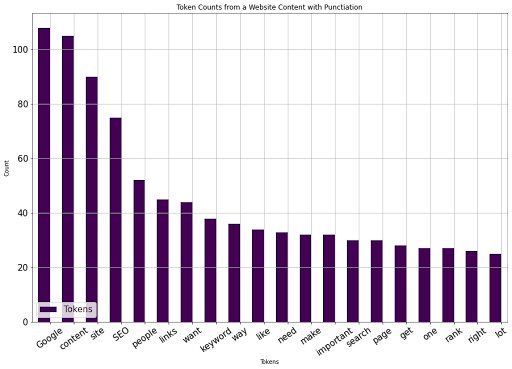
Screenshot from creator, August 2022We see essentially the most used phrases within the “Search Engine Optimization” associated rating net doc.
With Panda’s “plot” methodology, we will visualize it simply as under.
counts_of_words_df.head(20).plot(form="bar",x="index", orientation="vertical", figsize=(15,10), xlabel="Tokens", ylabel="Depend", colormap="viridis", desk=False, grid=True, fontsize=15, rot=35, place=1, title="Token Counts from a Web site Content material with Punctiation", legend=True).legend(["Tokens"], loc="decrease left", prop={"measurement":15})Clarification of code block above:
- Use the pinnacle methodology to see the primary significant values to have a clear visualization.
- Use “plot” with the “form” attribute to have a “bar plot.”
- Put the “x” axis with the columns that contain the phrases.
- Use the orientation attribute to specify the path of the plot.
- Decide figsize with a tuple that specifies top and width.
- Put x and y labels for x and y axis names.
- Decide a colormap that has a assemble comparable to “viridis.”
- Decide font measurement, label rotation, label place, the title of plot, legend existence, legend title, location of legend, and measurement of the legend.
The Pandas DataFrame Plotting is an intensive matter. If you wish to use the “Plotly” as Pandas visualization back-end, test the Visualization of Scorching Matters for Information search engine marketing.
You may see the consequence under.
 Picture from creator, August 2022
Now, we will select our second URL to begin our comparability of vocabulary measurement and incidence of phrases.
8. Select The Second URL For Comparability Of The Vocabulary Dimension And Occurrences Of Phrases
To check the earlier search engine marketing content material to a competing net doc, we are going to use SEJ’s search engine marketing information. You may see a compressed model of the steps adopted till now for the second article.
def tokenize_visualize(article:int):

    stop_words = set(stopwords.phrases("english"))

    removed_curly_quotes = "’“”"

    tokenized_words = word_tokenize(crawled_df["body_text"][article])

    print("Depend of tokenized phrases:", len(tokenized_words))

    tokenized_words = [word for word in tokenized_words if not word.lower() in stop_words and word.lower() not in string.punctuation and word.lower() not in removed_curly_quotes]

    print("Depend of tokenized phrases after elimination punctations, and cease phrases:", len(tokenized_words))

    counted_tokenized_words = Counter(tokenized_words)

    counts_of_words_df = pd.DataFrame.from_dict(

    counted_tokenized_words, orient="index").reset_index()

    counts_of_words_df.sort_values(by=0, ascending=False, inplace=True)

    #counts_of_words_df["index"] = counts_of_words_df["index"].apply(lambda x: float("NaN") if x in removed_curly_quotes else x)

    counts_of_words_df.dropna(inplace=True)

    counts_of_words_df.head(20).plot(form="bar",

    x="index",

    orientation="vertical",

    figsize=(15,10),

    xlabel="Tokens",

    ylabel="Depend",

    colormap="viridis",

    desk=False,

    grid=True,

    fontsize=15,

    rot=35,

    place=1,

    title="Token Counts from a Web site Content material with Punctiation",

    legend=True).legend(["Tokens"],

    loc="decrease left",

    prop={"measurement":15})
We collected the whole lot for tokenization, elimination of cease phrases, punctations, changing curly quotations, counting phrases, knowledge body building, knowledge body sorting, and visualization.
Beneath, you may see the consequence.
 Screenshot by creator, August 2022
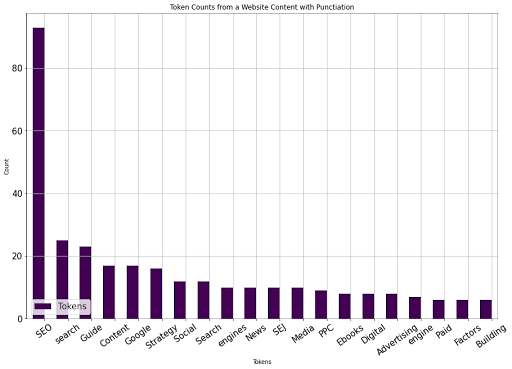
The SEJ article is within the eighth rating.
tokenize_visualize(8)The quantity eight means it ranks eighth on the crawl output knowledge body, equal to the SEJ article for search engine marketing. You may see the consequence under.
 Picture from creator, August 2022
We see that the 20 most used phrases between the SEJ search engine marketing article and different competing search engine marketing articles differ.
9. Create A Customized Perform To Automate Phrase Prevalence Counts And Vocabulary Distinction Visualization
The basic step to automating any search engine marketing process with Python is wrapping all of the steps and requirements underneath a sure Python perform with totally different potentialities.
The perform that you will notice under has a conditional assertion. For those who cross a single article, it makes use of a single visualization name; for a number of ones, it creates sub-plots in accordance with the sub-plot depend.
def tokenize_visualize(articles:record, article:int=None):

     if article:

          stop_words = set(stopwords.phrases("english"))

          removed_curly_quotes = "’“”"

          tokenized_words = word_tokenize(crawled_df["body_text"][article])

          print("Depend of tokenized phrases:", len(tokenized_words))

          tokenized_words = [word for word in tokenized_words if not word.lower() in stop_words and word.lower() not in string.punctuation and word.lower() not in removed_curly_quotes]

          print("Depend of tokenized phrases after elimination punctations, and cease phrases:", len(tokenized_words))

          counted_tokenized_words = Counter(tokenized_words)

          counts_of_words_df = pd.DataFrame.from_dict(

          counted_tokenized_words, orient="index").reset_index()

          counts_of_words_df.sort_values(by=0, ascending=False, inplace=True)

          #counts_of_words_df["index"] = counts_of_words_df["index"].apply(lambda x: float("NaN") if x in removed_curly_quotes else x)

          counts_of_words_df.dropna(inplace=True)

          counts_of_words_df.head(20).plot(form="bar",

          x="index",

          orientation="vertical",

          figsize=(15,10),

          xlabel="Tokens",

          ylabel="Depend",

          colormap="viridis",

          desk=False,

          grid=True,

          fontsize=15,

          rot=35,

          place=1,

          title="Token Counts from a Web site Content material with Punctiation",

          legend=True).legend(["Tokens"],

          loc="decrease left",

          prop={"measurement":15})


     if articles:

          source_names = []

          for i in vary(len(articles)):

               source_name = crawled_df["url"][articles[i]]

               print(source_name)

               source_name = urlparse(source_name)

               print(source_name)

               source_name = source_name.netloc

               print(source_name)

               source_names.append(source_name)

          international dfs

          dfs = []

          for i in articles:

               stop_words = set(stopwords.phrases("english"))

               removed_curly_quotes = "’“”"

               tokenized_words = word_tokenize(crawled_df["body_text"][i])

               print("Depend of tokenized phrases:", len(tokenized_words))

               tokenized_words = [word for word in tokenized_words if not word.lower() in stop_words and word.lower() not in string.punctuation and word.lower() not in removed_curly_quotes]

               print("Depend of tokenized phrases after elimination punctations, and cease phrases:", len(tokenized_words))

               counted_tokenized_words = Counter(tokenized_words)

               counts_of_words_df = pd.DataFrame.from_dict(

               counted_tokenized_words, orient="index").reset_index()

               counts_of_words_df.sort_values(by=0, ascending=False, inplace=True)

               #counts_of_words_df["index"] = counts_of_words_df["index"].apply(lambda x: float("NaN") if x in removed_curly_quotes else x)

               counts_of_words_df.dropna(inplace=True)

               df_individual = counts_of_words_df

               dfs.append(df_individual)


          import matplotlib.pyplot as plt

          determine, axes = plt.subplots(len(articles), 1)

          for i in vary(len(dfs) + 0):

               dfs[i].head(20).plot(ax = axes[i], form="bar",

                    x="index",

                    orientation="vertical",

                    figsize=(len(articles) * 10, len(articles) * 10),

                    xlabel="Tokens",

                    ylabel="Depend",

                    colormap="viridis",

                    desk=False,

                    grid=True,

                    fontsize=15,

                    rot=35,

                    place=1,

                    title= f"{source_names[i]} Token Counts",

                    legend=True).legend(["Tokens"],

                    loc="decrease left",

                    prop={"measurement":15})
To maintain the article concise, I received’t add a proof for these. Nonetheless, when you test earlier SEJ Python search engine marketing tutorials I’ve written, you’ll notice comparable wrapper features.
Let’s use it.
tokenize_visualize(articles=[1, 8, 4])
We needed to take the primary, eighth, and fourth articles and visualize their prime 20 phrases and their occurrences; you may see the consequence under.
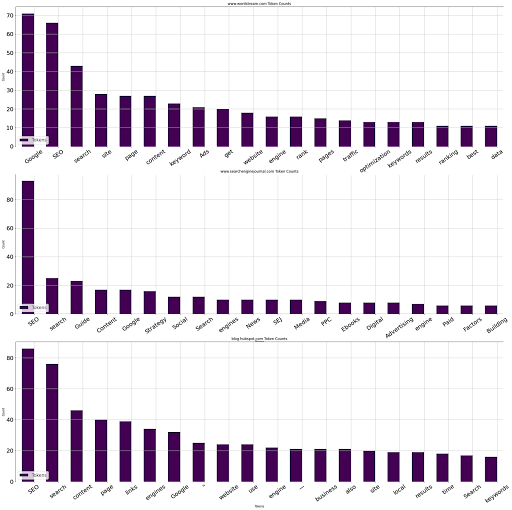 Picture from creator, August 2022
10. Examine The Distinctive Phrase Depend Between The Paperwork
Evaluating the distinctive phrase depend between the paperwork is sort of simple, due to pandas. You may test the customized perform under.
def compare_unique_word_count(articles:record):

     source_names = []

     for i in vary(len(articles)):

          source_name = crawled_df["url"][articles[i]]

          source_name = urlparse(source_name)

          source_name = source_name.netloc

          source_names.append(source_name)


     stop_words = set(stopwords.phrases("english"))

     removed_curly_quotes = "’“”"

     i = 0

     for article in articles:

          textual content = crawled_df["body_text"][article]

          tokenized_text = word_tokenize(textual content)

          tokenized_cleaned_text = [word for word in tokenized_text if not word.lower() in stop_words if not word.lower() in string.punctuation if not word.lower() in removed_curly_quotes]

          tokenized_cleanet_text_counts = Counter(tokenized_cleaned_text)

          tokenized_cleanet_text_counts_df = pd.DataFrame.from_dict(tokenized_cleanet_text_counts, orient="index").reset_index().rename(columns={"index": source_names[i], 0: "Counts"}).sort_values(by="Counts", ascending=False)

          i += 1

          print(tokenized_cleanet_text_counts_df, "Variety of distinctive phrases: ",  tokenized_cleanet_text_counts_df.nunique(), "Whole contextual phrase depend: ", tokenized_cleanet_text_counts_df["Counts"].sum(), "Whole phrase depend: ", len(tokenized_text))

compare_unique_word_count(articles=[1, 8, 4])
The result’s under.
The underside of the consequence reveals the variety of distinctive values, which reveals the variety of distinctive phrases within the doc.
www.wordstream.com Counts
16 Google 71
82 search engine marketing 66
186 search 43
228 website 28
274 web page 27
… … …
510 markup/structured 1
1 Latest 1
514 mistake 1
515 backside 1
1024 LinkedIn 1
[1025 rows x 2 columns] Variety of distinctive phrases:
www.wordstream.com 1025
Counts 24
dtype: int64 Whole contextual phrase depend: 2399 Whole phrase depend: 4918
www.searchenginejournal.com Counts
9 search engine marketing 93
242 search 25
64 Information 23
40 Content material 17
13 Google 17
.. … …
229 Motion 1
228 Transferring 1
227 Agile 1
226 32 1
465 information 1
[466 rows x 2 columns] Variety of distinctive phrases:
www.searchenginejournal.com 466
Counts 16
dtype: int64 Whole contextual phrase depend: 1019 Whole phrase depend: 1601
weblog.hubspot.com Counts
166 search engine marketing 86
160 search 76
32 content material 46
368 web page 40
327 hyperlinks 39
… … …
695 concept 1
697 talked 1
698 earlier 1
699 Analyzing 1
1326 Safety 1
[1327 rows x 2 columns] Variety of distinctive phrases:
weblog.hubspot.com 1327
Counts 31
dtype: int64 Whole contextual phrase depend: 3418 Whole phrase depend: 6728
There are 1025 distinctive phrases out of 2399 non-stopword and non-punctuation contextual phrases. The entire phrase depend is 4918.
Essentially the most used 5 phrases are “Google,” “search engine marketing,” “search,” “website,” and “web page” for “Wordstream.” You may see the others with the identical numbers.
11. Examine The Vocabulary Variations Between The Paperwork On The SERP
Auditing what distinctive phrases seem in competing paperwork helps you see the place the doc weighs extra and the way it creates a distinction.
The methodology is straightforward: “set” object kind has a “distinction” methodology to indicate the totally different values between two units.
def audit_vocabulary_difference(articles:record):

     stop_words = set(stopwords.phrases("english"))

     removed_curly_quotes = "’“”"

     international dfs

     international source_names

     source_names = []

     for i in vary(len(articles)):

          source_name = crawled_df["url"][articles[i]]

          source_name = urlparse(source_name)

          source_name = source_name.netloc

          source_names.append(source_name)

     i = 0

     dfs = []

     for article in articles:

               textual content = crawled_df["body_text"][article]

               tokenized_text = word_tokenize(textual content)

               tokenized_cleaned_text = [word for word in tokenized_text if not word.lower() in stop_words if not word.lower() in string.punctuation if not word.lower() in removed_curly_quotes]

               tokenized_cleanet_text_counts = Counter(tokenized_cleaned_text)

               tokenized_cleanet_text_counts_df = pd.DataFrame.from_dict(tokenized_cleanet_text_counts, orient="index").reset_index().rename(columns={"index": source_names[i], 0: "Counts"}).sort_values(by="Counts", ascending=False)

               tokenized_cleanet_text_counts_df.dropna(inplace=True)

               i += 1

               df_individual = tokenized_cleanet_text_counts_df

               dfs.append(df_individual)

     international vocabulary_difference

     vocabulary_difference = []

     for i in dfs:

          vocabulary = set(i.iloc[:, 0].to_list())

          vocabulary_difference.append(vocabulary)

     print( "Phrases that seem on :", source_names[0], "however not on: ", source_names[1], "are under: n", vocabulary_difference[0].distinction(vocabulary_difference[1]))
To maintain issues concise, I received’t clarify the perform strains one after the other, however principally, we take the distinctive phrases in a number of articles and examine them to one another.
You may see the consequence under.
Phrases that seem on: www.techtarget.com however not on: moz.com are under:
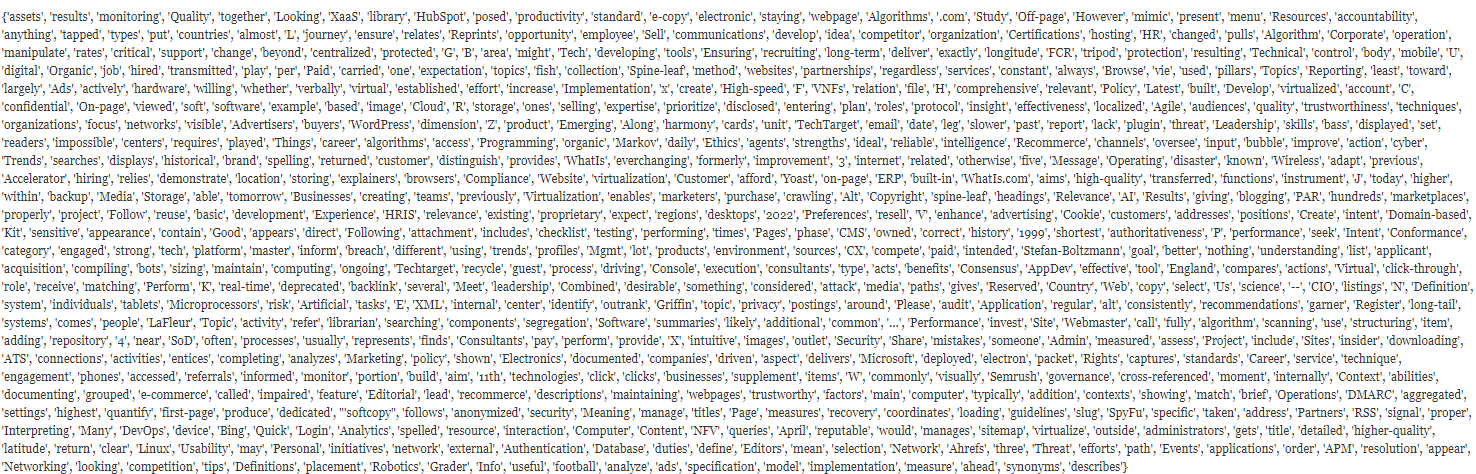 Screenshot by creator, August 2022
Use the customized perform under to see how typically these phrases are used within the particular doc.
def unique_vocabulry_weight():

     audit_vocabulary_difference(articles=[3, 1])

vocabulary_difference_list = vocabulary_difference_df[0].to_list()

     return dfs[0][dfs[0].iloc[:, 0].isin(vocabulary_difference_list)]

unique_vocabulry_weight()
The outcomes are under.
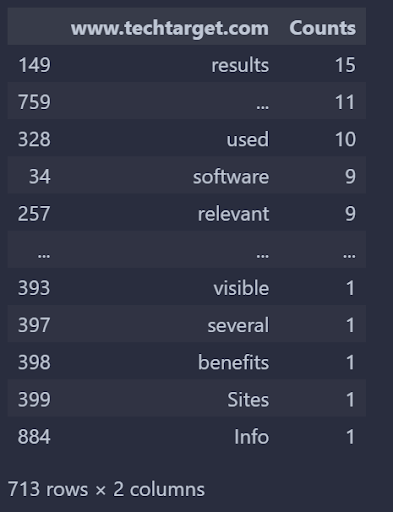 Screenshot by creator, August 2022
The vocabulary distinction between TechTarget and Moz for the “SEO” question from TechTarget’s perspective is above. We will reverse it.
def unique_vocabulry_weight():

audit_vocabulary_difference(articles=[1, 3])

vocabulary_difference_list = vocabulary_difference_df[0].to_list()

return dfs[0][dfs[0].iloc[:, 0].isin(vocabulary_difference_list)]

unique_vocabulry_weight()
Change the order of numbers. Examine from one other perspective.
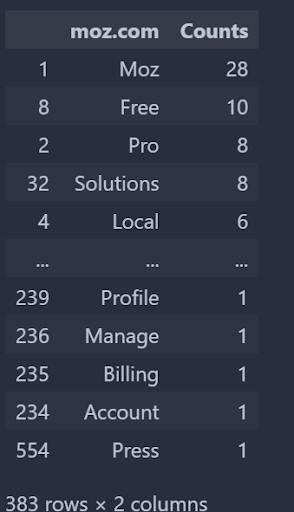 Screenshot by creator, August 2022
You may see that Wordstream has 868 distinctive phrases that don’t seem on Boosmart, and the highest 5 and tail 5 are given above with their occurrences.
The vocabulary distinction audit might be improved with “weighted frequency” by checking the question data and community.
However, for educating functions, that is already a heavy, detailed, and superior Python, Information Science, and search engine marketing intensive course.
See you within the subsequent guides and tutorials.
Extra assets:
Featured Picture: VectorMine/Shutterstock
[ad_2]

