[ad_1]
Detection engineers and risk hunters perceive that concentrating on adversary behaviors is a necessary a part of an efficient detection technique (suppose Pyramid of Ache). But, inherent in focusing analytics on adversary behaviors is that malicious habits will typically sufficient overlap with benign habits in your surroundings, particularly as adversaries attempt to mix in and more and more dwell off the land. Think about you’re getting ready to deploy a behavioral analytic to enrich your detection technique. Doing so may embody customized growth, attempting out a brand new Sigma rule, or new behavioral detection content material out of your safety info and occasion administration (SIEM) vendor. Maybe you’re contemplating automating a earlier hunt, however sadly you discover that the goal habits is widespread in your surroundings.
Is that this a foul detection alternative? Not essentially. What are you able to do to make the analytic outputs manageable and never overwhelm the alert queue? It’s typically stated that it’s essential to tune the analytic on your surroundings to scale back the false optimistic price. However are you able to do it with out sacrificing analytic protection? On this submit, I focus on a course of for tuning and associated work you are able to do to make such analytics extra viable in your surroundings. I additionally briefly focus on correlation, another and complementary means to handle noisy analytic outputs.
Tuning the Analytic
As you’re growing and testing the analytic, you’re inevitably assessing the next key questions, the solutions to which in the end dictate the necessity for tuning:
- Does the analytic accurately determine the goal habits and its variations?
- Does the analytic determine different habits totally different than the intention?
- How widespread is the habits in your surroundings?
Right here, let’s assume the analytic is correct and pretty strong as a way to deal with the final query. Given these assumptions, let’s depart from the colloquial use of the time period false optimistic and as a substitute use benign optimistic. This time period refers to benign true optimistic occasions by which the analytic accurately identifies the goal habits, however the habits displays benign exercise.
If the habits principally by no means occurs, or occurs solely sometimes, then the variety of outputs will sometimes be manageable. You may settle for these small numbers and proceed to documenting and deploying the analytic. Nonetheless, on this submit, the goal habits is widespread in your surroundings, which suggests it’s essential to tune the analytic to forestall overwhelming the alert queue and to maximise the potential sign of its outputs. At this level, the fundamental goal of tuning is to scale back the variety of outcomes produced by the analytic. There are typically two methods to do that:
- Filter out the noise of benign positives (our focus right here).
- Modify the specificity of the analytic.
Whereas not the main target of this submit, let’s briefly focus on adjusting the specificity of the analytic. Adjusting specificity means narrowing the view of the analytic, which entails adjusting its telemetry supply, logical scope, and/or environmental scope. Nonetheless, there are protection tradeoffs related to doing this. Whereas there may be all the time a stability to be struck attributable to useful resource constraints, basically it’s higher (for detection robustness and sturdiness) to solid a large internet; that’s, select telemetry sources and assemble analytics that broadly determine the goal habits throughout the broadest swath of your surroundings. Basically, you’re selecting to simply accept a bigger variety of attainable outcomes as a way to keep away from false negatives (i.e., fully lacking doubtlessly malicious cases of the goal habits). Due to this fact, it’s preferable to first focus tuning efforts on filtering out benign positives over adjusting specificity, if possible.
Filtering Out Benign Positives
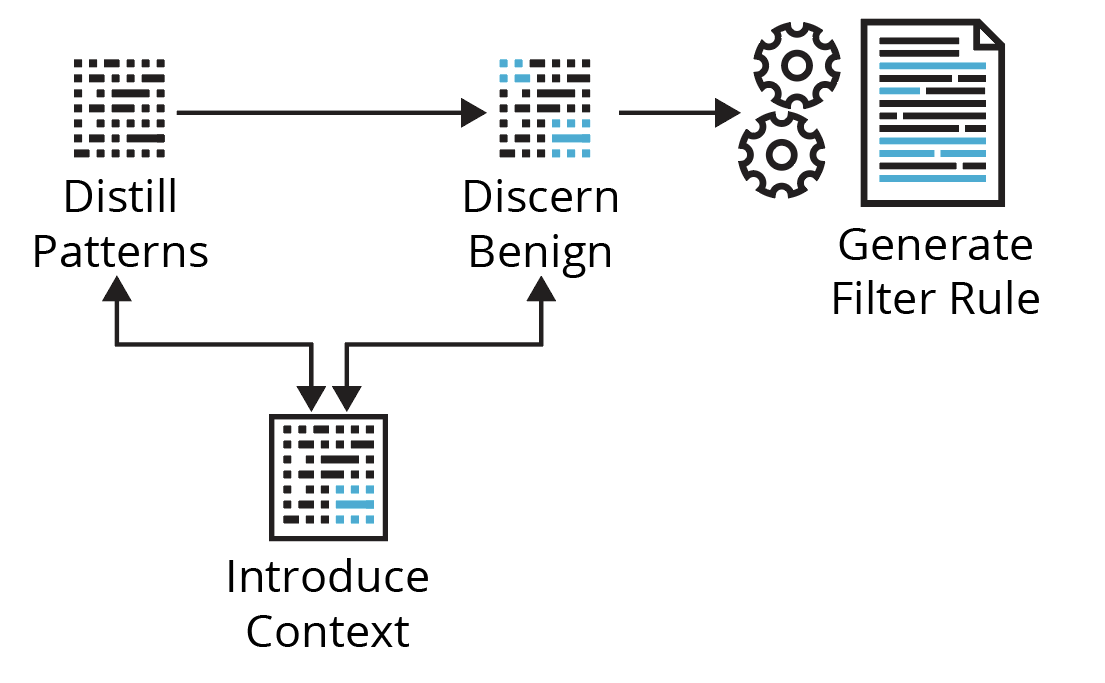
Working the analytic during the last, say, week of manufacturing telemetry, you’re introduced with a desk of quite a few outcomes. Now what? Determine 1 under reveals the cyclical course of we’ll stroll by way of utilizing a few examples concentrating on Kerberoasting and Non-Normal Port methods.
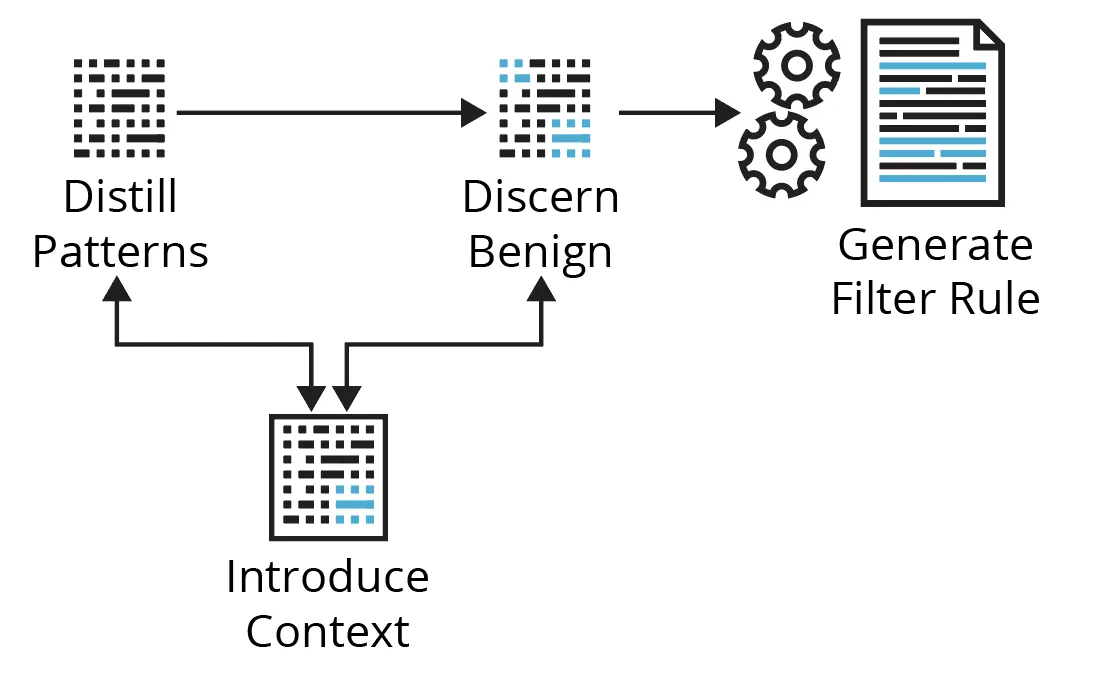
Determine 1: A Fundamental Course of for Filtering Out Benign Positives
Distill Patterns
Coping with quite a few analytic outcomes doesn’t essentially imply it’s important to observe down each individually or have a filter for every end result—the sheer quantity makes that impractical. A whole bunch of outcomes can doubtlessly be distilled to a couple filters—it will depend on the out there context. Right here, you’re seeking to discover the info to get a way of the highest entities concerned, the number of related contextual values (context cardinality), how typically these change (context velocity), and which related fields could also be summarized. Begin with entities or values related to probably the most outcomes; that’s, attempt to handle the biggest chunks of associated occasions first.
Examples
- Kerberoasting—Say this Sigma rule returns outcomes with many alternative AccountNames and ClientAddresses (excessive context cardinality), however most outcomes are related to comparatively few ServiceNames (of sure legacy units; low context cardinality) and TicketOptions. You broaden the search to the final 30 days and discover the ServiceNames and TicketOptions are the a lot the identical (low context velocity), however different related fields have extra and/or totally different values (excessive context velocity). You’d deal with these ServiceNames and/or TicketOptions, verify it’s anticipated/recognized exercise, then handle an enormous chunk of the outcomes with a single filter towards these ServiceNames.
- Non-Normal Port—On this instance, you discover there may be excessive cardinality and excessive velocity in nearly each occasion/community circulate area, aside from the service/utility label, which signifies that solely SSL/TLS is getting used on non-standard ports. Once more, you broaden the search and see lots of totally different supply IPs that could possibly be summarized by a single Classless Inter-Area Routing (CIDR) block, thus abstracting the supply IP into a chunk of low-cardinality, low-velocity context. You’d deal with this obvious subnet, attempting to grasp what it’s and any related controls round it, verify its anticipated and/or recognized exercise, then filter accordingly.
Thankfully, there are often patterns within the information you can deal with. You typically wish to goal context with low cardinality and low velocity as a result of it impacts the long-term effectiveness of your filters. You don’t wish to continually be updating your filter guidelines by counting on context that adjustments too typically should you can assist it. Nonetheless, generally there are numerous high-cardinality, high-velocity fields, and nothing fairly stands out from primary stacking, counting, or summarizing. What should you can’t slim the outcomes as is? There are too many outcomes to analyze each individually. Is that this only a dangerous detection alternative? Not but.
Discern Benign
The primary concern on this exercise is shortly gathering enough context to disposition analytic outputs with a suitable stage of confidence. Context is any information or info that meaningfully contributes to understanding and/or decoding the circumstances/situations by which an occasion/alert happens, to discern habits as benign, malicious, or suspicious/unknown. Desk 1 under describes the commonest forms of context that you’ll have or search to assemble.
Desk 1: Frequent Forms of Context
|
Kind |
Description |
Typical Sources |
Instance(s) |
| Occasion | primary properties/parameters of the occasion that assist outline it | uncooked telemetry, log fields |
course of creation fields, community circulate fields, course of community connection fields, Kerberos service ticket request fields |
| Environmental | information/details about the monitored surroundings or belongings within the monitored surroundings |
CMDB /ASM/IPAM, ticket system, documentation, the brains of different analysts, admins, engineers, system/community homeowners |
enterprise processes, community structure, routing, proxies, NAT, insurance policies, permitted change requests, providers used/uncovered, recognized vulnerabilities, asset possession, {hardware}, software program, criticality, location, enclave, and so forth. |
| Entity | information/details about the entities (e.g., id, supply/vacation spot host, course of, file) concerned within the occasion |
IdP /IAM, EDR, CMDB /ASM/IPAM, Third-party APIs |
• enriching a public IP handle with geolocation, < href=”https://en.wikipedia.org/wiki/Autonomous_system_percent28Internetpercent29”>ASN information, passive DNS, open ports/protocols/providers, certificates info
• enriching an id with description, kind, function, privileges, division, location, and so forth. |
| Historic | • how typically the occasion occurs
• how typically the occasion occurs with sure traits or entities, and/or • how typically there’s a relationship between choose entities concerned within the occasion |
baselines | • profiling the final 90 days of DNS requests per top-level area (TLD)
• profiling the final 90 days of HTTP on non-standard ports • profiling course of lineage |
| Risk | • assault (sub-)method(s)
• instance process(s) • probably assault stage • particular and/or kind of risk actor/malware/device recognized to exhibit the habits, • repute, scoring, and so forth. |
risk intelligence platform (TIP), MITRE ATT&CK, risk intelligence APIs, documentation |
repute / detection scores, Sysmon-modular annotations, ADS instance |
| Analytic | • how and why this occasion was raised
• any related values produced/derived by the analytic itself • the analytic logic • recognized/widespread benign instance(s) • beneficial follow-on actions • scoring, and so forth. |
analytic processing,
documentation, runbooks |
"occasion": {
"processing": {
"time_since_flow_start": "0:04:08.641718",
"period": 0.97
},
"cause": "SEEN_BUT_RARELY_OCCURRING",
"consistency_score": 95
}
|
| Correlation | information/info from related occasions/alerts (mentioned under in Aggregating the Sign ) |
SIEM/SOAR, customized correlation layer |
risk-based alerting, correlation guidelines |
| Open-source | information/info typically out there by way of Web search engines like google | Web | vendor documentation states what service names they use, what different folks have seen relating to TCP/2323 |
Upon preliminary evaluate, you’ve gotten the occasion context, however you sometimes find yourself in search of environmental, entity, and/or historic context to ideally reply (1) which identities and software program prompted this exercise, and (2) is it legit? That’s, you’re in search of details about the provenance, expectations, controls, belongings, and historical past relating to the noticed exercise. But, that context could or is probably not out there or too sluggish to amass. What should you can’t inform from the occasion context? How else may you inform these occasions are benign or not? Is that this only a dangerous detection alternative? Not but. It will depend on your choices for gathering extra context and the pace of these choices.
Introduce Context
If there aren’t apparent patterns and/or the out there context is inadequate, you’ll be able to work to introduce patterns/context by way of automated enrichments and baselines. Enrichments could also be from inside or exterior information sources and are often automated lookups primarily based on some entity within the occasion (e.g., id, supply/vacation spot host, course of, file, and so forth.). Even when enrichment alternatives are scarce, you’ll be able to all the time introduce historic context by constructing baselines utilizing the info you’re already amassing.
With the multitude of monitoring and detection suggestions utilizing phrases similar to new, uncommon, sudden, uncommon, unusual, irregular, anomalous, by no means been seen earlier than, sudden patterns and metadata, doesn’t usually happen, and so forth., you’ll should be constructing and sustaining baselines anyway. Nobody else can do these for you—baselines will all the time be particular to your surroundings, which is each a problem and a bonus for defenders.
Kerberoasting
Until you’ve gotten programmatically accessible and up-to-date inside information sources to counterpoint the AccountName (id), ServiceName/ServiceID (id), and/or ClientAddress (supply host; sometimes RFC1918), there’s not a lot enrichment to do besides, maybe, to translate TicketOptions, TicketEncryptionType, and FailureCode to pleasant names/values. Nonetheless, you’ll be able to baseline these occasions. For instance, you may observe the next over a rolling 90-day interval:
- % days seen per ServiceName per AccountName → determine new/uncommon/widespread user-service relationships
- imply and mode of distinctive ServiceNames per AccountName per time interval → determine uncommon variety of providers for which a person makes service ticket requests
You would broaden the search (solely to develop a baseline metric) to all related TicketEncryption Sorts and moreover observe
- % days seen per TicketEncryptionType per ServiceName → determine new/uncommon/widespread service-encryption kind relationships
- % days seen per TicketOptions per AccountName → determine new/uncommon/widespread user-ticket choices relationships
- % days seen per TicketOptions per ServiceName → determine new/uncommon/widespread service-ticket choices relationships
Non-Normal Port
Enrichment of the vacation spot IP addresses (all public) is an effective place to start out, as a result of there are numerous free and industrial information sources (already codified and programmatically accessible by way of APIs) relating to Web-accessible belongings. You enrich analytic outcomes with geolocation, ASN, passive DNS, hosted ports, protocols, and providers, certificates info, major-cloud supplier info, and so forth. You now discover that the entire connections are going to a couple totally different netblocks owned by a single ASN, they usually all correspond to a single cloud supplier’s public IP ranges for a compute service in two totally different areas. Furthermore, passive DNS signifies a lot of development-related subdomains all on a well-known dad or mum area. Certificates info is constant over time (which signifies one thing about testing) and has acquainted organizational identifiers.
Newness is well derived—the connection is both traditionally there or it isn’t. Nonetheless, you’ll want to find out and set a threshold as a way to say what is taken into account uncommon and what’s thought of widespread. Having some codified and programmatically accessible inside information sources out there wouldn’t solely add doubtlessly beneficial context however broaden the choices for baseline relationships and metrics. The artwork and science of baselining includes figuring out thresholds and which baseline relationships/metrics will offer you significant sign.
Total, with some additional engineering and evaluation work, you’re in a significantly better place to distill patterns, discern which occasions are (most likely) benign, and to make some filtering selections. Furthermore, whether or not you construct automated enrichments and/or baseline checks into the analytic pipeline, or construct runbooks to assemble this context on the level of triage, this work feeds immediately into supporting detection documentation and enhances the general pace and high quality of triage.
Generate Filter Rule
You wish to neatly apply filters with out having to handle too many guidelines, however you wish to achieve this with out creating guidelines which can be too broad (which dangers filtering out malicious occasions, too). With filter/enable listing guidelines, quite than be overly broad, it’s higher to lean towards a extra exact description of the benign exercise and probably should create/handle a couple of extra guidelines.
Kerberoasting
The baseline info helps you perceive that these few ServiceNames do actually have a typical and constant historical past of occurring with the opposite related entities/properties of the occasions proven within the outcomes. You establish these are OK to filter out, and also you achieve this with a single, easy filter towards these ServiceNames.
Non-Normal Port
Enrichments have offered beneficial context to assist discern benign exercise and, importantly, additionally enabled the abstraction of the vacation spot IP, a high-cardinality, high-velocity area, from many alternative, altering values to a couple broader, extra static values described by ASN, cloud, and certificates info. Given this context, you establish these connections are most likely benign and transfer to filter them out. See Desk 2 under for instance filter guidelines, the place app=443 signifies SSL/TLS and major_csp=true signifies the vacation spot IP of the occasion is in one of many revealed public IP ranges of a significant cloud service supplier:
Desk 2: Instance Filter Guidelines
|
Kind |
Filter Rule |
Cause |
|---|---|---|
|
Too broad |
sip=10.2.16.0/22; app=443; asn=16509; major_csp=true |
You don’t wish to enable all non-standard port encrypted connections from the subnet to all cloud supplier public IP ranges in the complete ASN. |
|
Nonetheless too broad |
sip=10.2.16.0/22; app=443; asn=16509; major_csp=true; cloud_provider=aws; cloud_service=EC2; cloud_region=us-west-1,us-west-2 |
You don’t know the character of the inner subnet. You don’t wish to enable all non-standard port encrypted visitors to have the ability to hit simply any EC2 IPs throughout two whole areas. Cloud IP utilization adjustments as totally different clients spin up/down sources. |
|
Finest possibility |
sip=10.2.16.0/22; app=443; asn=16509; major_csp=true; cloud_provider=aws; cloud_service=EC2; cloud_region=us-west-1,us-west-2; cert_subject_dn=‘L=Earth|O=Your Org|OU=DevTest|CN=dev.your.org’ |
It is particular to the noticed testing exercise on your org, however broad sufficient that it shouldn’t change a lot. You’ll nonetheless learn about another non-standard port visitors that doesn’t match all of those traits. |
An essential corollary right here is that the filtering mechanism/enable listing must be utilized in the suitable place and be versatile sufficient to deal with the context that sufficiently describes the benign exercise. A easy filter on ServiceNames depends solely on information within the uncooked occasions and may be filtered out merely utilizing an additional situation within the analytic itself. Then again, the Non-Normal Port filter rule depends on information from the uncooked occasions in addition to enrichments, by which case these enrichments must have been carried out and out there within the information earlier than the filtering mechanism is utilized. It’s not all the time enough to filter out benign positives utilizing solely fields out there within the uncooked occasions. There are numerous methods you may account for these filtering situations. The capabilities of your detection and response pipeline, and the best way it’s engineered, will influence your means to successfully tune at scale.
Mixture the Sign
Up to now, I’ve talked a couple of course of for tuning a single analytic. Now, let’s briefly focus on a correlation layer, which operates throughout all analytic outputs. Typically an recognized habits simply isn’t a robust sufficient sign in isolation; it might solely develop into a robust sign in relation to different behaviors, recognized by different analytics. Correlating the outputs from a number of analytics can tip the sign sufficient to meaningfully populate the alert queue in addition to present beneficial extra context.
Correlation is usually entity-based, similar to aggregating analytic outputs primarily based on a shared entity like an id, host, or course of. These correlated alerts are sometimes prioritized by way of scoring, the place you assign a threat rating to every analytic output. In flip, correlated alerts could have an mixture rating that’s often the sum, or some normalized worth, of the scores of the related analytic outputs. You’d type correlated alerts by the combination rating, the place larger scores point out entities with probably the most, or most extreme, analytic findings.
The outputs out of your analytic don’t essentially should go on to the principle alert queue. Not each analytic output wants be triaged. Maybe the efficacy of the analytic primarily exists in offering extra sign/context in relation to different analytic outputs. As correlated alerts bubble as much as analysts solely when there may be robust sufficient sign between a number of related analytic outputs, correlation serves as a substitute and complementary means to make the variety of outputs from a loud analytic much less of a nuisance and total outputs extra manageable.
Enhancing Availability and Pace of Related Context
All of it activates context and the necessity to shortly collect enough context. Pace issues. Previous to operational deployment, the extra shortly and confidently you’ll be able to disposition analytic outputs, the extra outputs you’ll be able to take care of, the sooner and higher the tuning, the upper the potential sign of future analytic outputs, and the earlier you’ll have a viable analytic in place working for you. After deployment, the extra shortly and confidently you’ll be able to disposition analytic outputs, the sooner and higher the triage and the earlier applicable responses may be pursued. In different phrases, the pace of gathering enough context immediately impacts your imply time to detect and imply time to reply. Inversely, obstacles to shortly gathering enough context are obstacles to tuning/triage; are obstacles to viable, efficient, and scalable deployment of proactive/behavioral safety analytics; and are obstacles to early warning and threat discount. Consequently, something you are able to do to enhance the supply and/or pace of gathering related context is a worthwhile effort on your detection program. These issues embody:
- constructing and sustaining related baselines
- constructing and sustaining a correlation layer
- investing in automation by getting extra contextual info—particularly inside entities and environmental context—that’s codified, made programmatically accessible, and built-in
- constructing relationships and tightening up safety reporting/suggestions loops with related stakeholders—a holistic folks, course of, and know-how effort; take into account one thing akin to these automated safety bot use instances
- constructing relationships with safety engineering and admins so they’re extra keen to help in tweaking the sign
- supporting information engineering, infrastructure, and processing for automated enrichments, baseline checks, and upkeep
- tweaking configurations for detection, e.g., deception engineering, this instance with ticket instances, and so forth.
- tweaking enterprise processes for detection, e.g., hooks into sure permitted change requests, admins all the time do that little additional particular factor to let you realize it’s actually them, and so forth.
When you need assistance doing any of this stuff, or wish to focus on your detection engineering journey, please contact us.
Abstract
Analytics concentrating on adversary behaviors will typically sufficient require tuning on your surroundings because of the identification of each benign and malicious cases of that habits. Simply because a habits could also be widespread in your surroundings doesn’t essentially imply it’s a foul detection alternative or not well worth the analytic effort. One of many main methods of coping with such analytic outputs, with out sacrificing protection, is through the use of context (typically greater than is contained within the uncooked occasions) and versatile filtering to tune out benign positives. I advocate for detection engineers to carry out most of this work, primarily conducting a knowledge research and a few pre-operational triage of their very own analytic outcomes. This work typically entails a cycle of evaluating analytic outcomes to distill patterns, discerning benign habits, introducing context as needed, and at last filtering out benign occasions. We used a pair primary examples to point out how that cycle may play out.
If the instant context is inadequate to distill patterns and/or discern benign habits, detection engineers can nearly all the time complement it with automated enrichments and/or baselines. Automated enrichments are extra widespread for exterior, Web-accessible belongings and could also be more durable to return by for inside entities, however baselines can sometimes be constructed utilizing the info you’re already amassing. Plus, historic/entity-based context is among the most helpful context to have.
In searching for to provide viable, high quality analytics, detection engineers ought to exhaust, or a minimum of attempt, these choices earlier than dismissing an analytic effort or sacrificing its protection. It’s additional work, however doing this work not solely improves pre-operational tuning however pays dividends on post-operational deployment as analysts triage alerts/leads utilizing the additional context and well-documented analysis. Analysts are then in a greater place to determine and escalate findings but additionally to supply tuning suggestions. In addition to, tuning is a steady course of and a two-pronged effort between detection engineers and analysts, if solely as a result of threats and environments usually are not static.
The opposite main manner of coping with such analytic outputs, once more with out sacrificing protection, is by incorporating a correlation layer into your detection pipeline. Correlation can be extra work as a result of it provides one other layer of processing, and it’s important to rating analytic outputs. Scoring may be tough as a result of there are numerous issues to contemplate, similar to how dangerous every analytic output is within the grand scheme of issues, if/how it is best to weight and/or enhance scores to account for numerous circumstances (e.g., asset criticality, time), how it is best to normalize scores, whether or not it is best to calculate scores throughout a number of entities and which one takes priority, and so forth. Nonetheless, the advantages of correlation make it a worthwhile effort and a fantastic possibility to assist prioritize throughout all analytic outputs. Additionally, it successfully diminishes the issue of noisier analytics since not each analytic output is supposed to be triaged.
When you need assistance doing any of this stuff, or wish to focus on your detection engineering journey, please contact us.
[ad_2]