


[ad_1]
For a lot of vital software capabilities, together with streaming and e-commerce, monolithic structure is not enough. With present calls for for real-time occasion knowledge and cloud service utilization, many fashionable purposes, comparable to Netflix and Lyft, have shifted to an event-driven microservices method. Separated microservices can function independently of each other and improve a code base’s adaptability and scalability.
However what’s an event-driven microservices structure, and why must you use it? We’ll study the foundational points and create a whole blueprint for an event-driven microservices mission utilizing Python and Apache Kafka.
Utilizing Occasion-driven Microservices
Occasion-driven microservices mix two fashionable structure patterns: microservices architectures and event-driven architectures. Although microservices can pair with request-driven REST architectures, event-driven architectures have gotten more and more related with the rise of massive knowledge and cloud platform environments.
What Is a Microservices Structure?
A microservices structure is a software program improvement approach that organizes an software’s processes as loosely coupled providers. It’s a kind of service-oriented structure (SOA).
In a conventional monolithic construction, all software processes are inherently interconnected; if one half fails, the system goes down. Microservices architectures as a substitute group software processes into separate providers interacting with light-weight protocols, offering improved modularity and higher app maintainability and resiliency.

Although monolithic purposes could also be less complicated to develop, debug, check, and deploy, most enterprise-level purposes flip to microservices as their customary, which permits builders to personal parts independently. Profitable microservices must be saved so simple as attainable and talk utilizing messages (occasions) which are produced and despatched to an occasion stream or consumed from an occasion stream. JSON, Apache Avro, and Google Protocol Buffers are frequent selections for knowledge serialization.
What Is an Occasion-driven Structure?
An event-driven structure is a design sample that buildings software program in order that occasions drive the habits of an software. Occasions are significant knowledge generated by actors (i.e., human customers, exterior purposes, or different providers).
Our instance mission options this structure; at its core is an event-streaming platform that manages communication in two methods:
- Receiving messages from actors that write them (often known as publishers or producers)
- Sending messages to different actors that learn them (often known as subscribers or customers)
In additional technical phrases, our event-streaming platform is software program that acts because the communication layer between providers and permits them to change messages. It may possibly implement a wide range of messaging patterns, comparable to publish/subscribe or point-to-point messaging, in addition to message queues.

Utilizing an event-driven structure with an event-streaming platform and microservices affords a wealth of advantages:
- Asynchronous communications: The flexibility to independently multitask permits providers to react to occasions every time they’re prepared as a substitute of ready on a earlier activity to complete earlier than beginning the following one. Asynchronous communications facilitate real-time knowledge processing and make purposes extra reactive and maintainable.
- Full decoupling and suppleness: The separation of producer and client parts signifies that providers solely must work together with the event-streaming platform and the info format they will produce or devour. Companies can comply with the single duty precept and scale independently. They’ll even be applied by separate improvement groups utilizing distinctive expertise stacks.
- Reliability and scalability: The asynchronous, decoupled nature of event-driven architectures additional amplifies app reliability and scalability (that are already benefits of microservices structure design).
With event-driven architectures, it’s straightforward to create providers that react to any system occasion. You can too create semi-automatic pipelines that embody some guide actions. (For instance, a pipeline for automated consumer payouts may embody a guide safety verify triggered by unusually massive payout values earlier than transferring funds.)
Selecting the Venture Tech Stack
We’ll create our mission utilizing Python and Apache Kafka paired with Confluent Cloud. Python is a sturdy, dependable customary for a lot of forms of software program tasks; it boasts a big group and plentiful libraries. It’s a good selection for creating microservices as a result of its frameworks are suited to REST and event-driven purposes (e.g., Flask and Django). Microservices written in Python are additionally generally used with Apache Kafka.
Apache Kafka is a well known event-streaming platform that makes use of a publish/subscribe messaging sample. It’s a frequent selection for event-driven architectures attributable to its in depth ecosystem, scalability (the results of its fault-tolerance talents), storage system, and stream processing talents.
Lastly, we’ll use Confluent as our cloud platform to effectively handle Kafka and supply out-of-the-box infrastructure. AWS MSK is one other wonderful possibility if you happen to’re utilizing AWS infrastructure, however Confluent is less complicated to arrange as Kafka is the core a part of its system and it affords a free tier.
Implementing the Venture Blueprint
We’ll arrange our Kafka microservices instance in Confluent Cloud, create a easy message producer, then set up and enhance it to optimize scalability. By the tip of this tutorial, we could have a functioning message producer that efficiently sends knowledge to our cloud cluster.
Kafka Setup
We’ll first create a Kafka cluster. Kafka clusters host Kafka servers that facilitate communication. Producers and customers interface with the servers utilizing Kafka matters (classes storing data).
- Join Confluent Cloud. When you create an account, the welcome web page seems with choices for creating a brand new Kafka cluster. Choose the Primary configuration.
- Select a cloud supplier and area. It is best to optimize your selections for the very best cloud ping outcomes out of your location. One possibility is to decide on AWS and carry out a cloud ping check (click on HTTP Ping) to determine the very best area. (For the scope of our tutorial, we’ll go away the “Single zone” possibility chosen within the “Availability” area.)
- The following display asks for a fee setup, which we are able to skip since we’re on a free tier. After that, we’ll enter our cluster title (e.g., “MyFirstKafkaCluster”), affirm our settings, and choose Launch cluster.
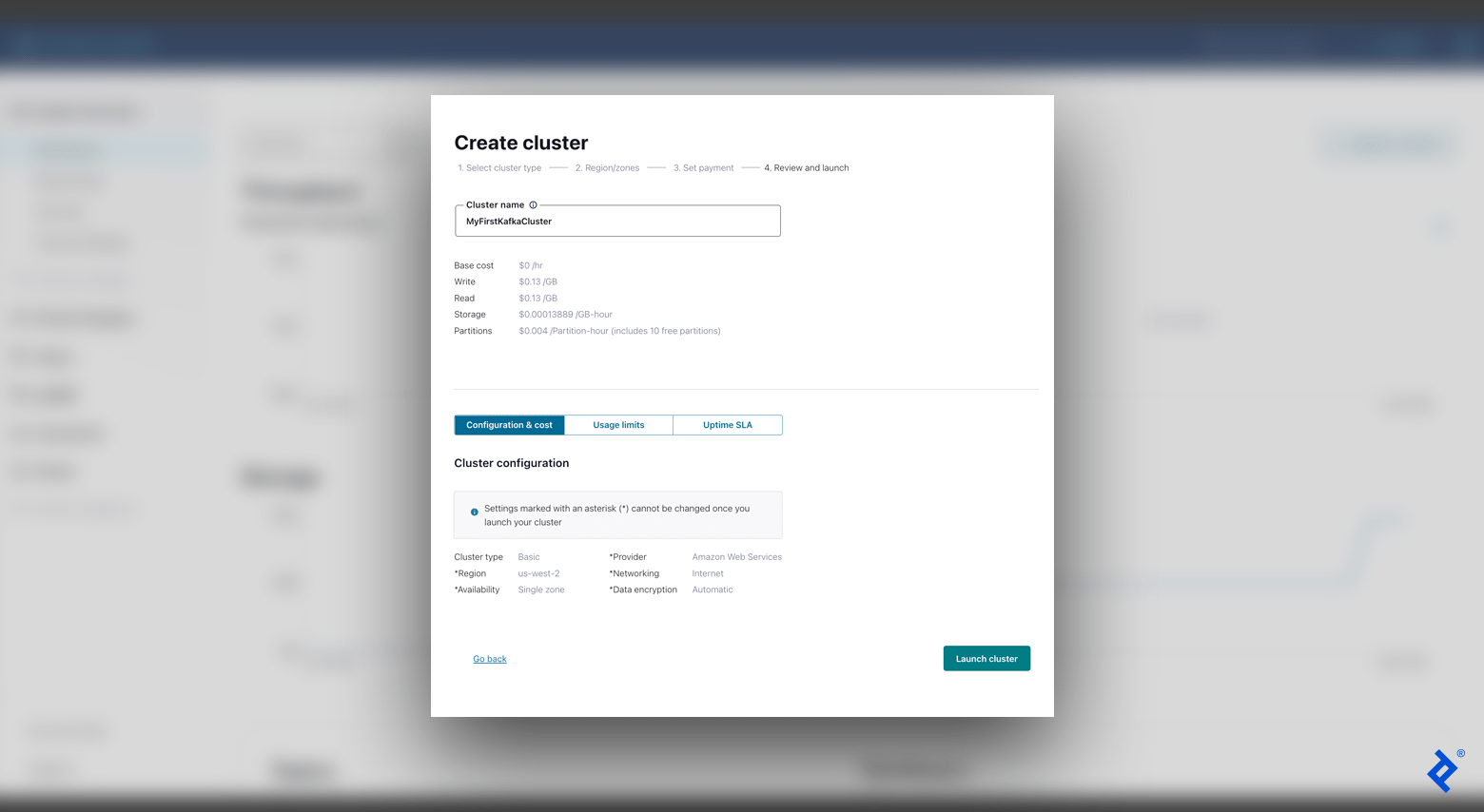
With a working cluster, we’re able to create our first matter. Within the left-hand menu bar, navigate to Matters and click on Create matter. Add a subject title (e.g., “MyFirstKafkaTopic”) and proceed with the default configurations (together with setting six partitions).
Earlier than creating our first message, we should arrange our shopper. We will simply Configure a shopper from our newly created matter overview (alternatively, within the left-hand menu bar, navigate to Shoppers). We’ll use Python as our language after which click on Create Kafka cluster API key.

At this level, our event-streaming platform is lastly able to obtain messages from our producer.
Easy Message Producer
Our producer generates occasions and sends them to Kafka. Let’s write some code to create a easy message producer. I like to recommend establishing a digital surroundings for our mission since we will probably be putting in a number of packages in our surroundings.
First, we’ll add our surroundings variables from the API configuration from Confluent Cloud. To do that in our digital surroundings, we’ll add export SETTING=worth for every setting beneath to the tip of our activate file (alternatively, you may add SETTING=worth to your .env file):
export KAFKA_BOOTSTRAP_SERVERS=<bootstrap.servers>
export KAFKA_SECURITY_PROTOCOL=<safety.protocol>
export KAFKA_SASL_MECHANISMS=<sasl.mechanisms>
export KAFKA_SASL_USERNAME=<sasl.username>
export KAFKA_SASL_PASSWORD=<sasl.password>
Ensure that to exchange every entry along with your Confluent Cloud values (for instance, <sasl.mechanisms> must be PLAIN), along with your API key and secret because the username and password. Run supply env/bin/activate, then printenv. Our new settings ought to seem, confirming that our variables have been accurately up to date.
We will probably be utilizing two Python packages:
We’ll run the command pip set up confluent-kafka python-dotenv to put in these. There are a lot of different packages for Kafka in Python which may be helpful as you develop your mission.
Lastly, we’ll create our primary producer utilizing our Kafka settings. Add a simple_producer.py file:
# simple_producer.py
import os

from confluent_kafka import KafkaException, Producer
from dotenv import load_dotenv

def foremost():
    settings = {
        'bootstrap.servers': os.getenv('KAFKA_BOOTSTRAP_SERVERS'),
        'safety.protocol': os.getenv('KAFKA_SECURITY_PROTOCOL'),
        'sasl.mechanisms': os.getenv('KAFKA_SASL_MECHANISMS'),
        'sasl.username': os.getenv('KAFKA_SASL_USERNAME'),
        'sasl.password': os.getenv('KAFKA_SASL_PASSWORD'),
    }

    producer = Producer(settings)
    producer.produce(
        matter='MyFirstKafkaTopic',
                      key=None,
                      worth='MyFirstValue-111',
    )
    producer.flush()  # Watch for the affirmation that the message was acquired

if __name__ == '__main__':
    load_dotenv()
    foremost()
With this simple code we create our producer and ship it a easy check message. To check the end result, run python3 simple_producer.py:

Checking our Kafka cluster’s Cluster Overview > Dashboard, we’ll see a brand new knowledge level on our Manufacturing graph for the message despatched.
Customized Message Producer
Our producer is up and operating. Let’s reorganize our code to make our mission extra modular and OOP-friendly. It will make it simpler so as to add providers and scale our mission sooner or later. We’ll break up our code into 4 information:
-
kafka_settings.py: Holds our Kafka configurations. -
kafka_producer.py: Incorporates a customizedproduce()technique and error dealing with. -
kafka_producer_message.py: Handles completely different enter knowledge sorts. -
advanced_producer.py: Runs our ultimate app utilizing our customized courses.
First, our KafkaSettings class will encapsulate our Apache Kafka settings, so we are able to simply entry these from our different information with out repeating code:
# kafka_settings.py
import os

class KafkaSettings:
    def __init__(self):
                      self.conf = {
            'bootstrap.servers': os.getenv('KAFKA_BOOTSTRAP_SERVERS'),
            'safety.protocol': os.getenv('KAFKA_SECURITY_PROTOCOL'),
            'sasl.mechanisms': os.getenv('KAFKA_SASL_MECHANISMS'),
            'sasl.username': os.getenv('KAFKA_SASL_USERNAME'),
            'sasl.password': os.getenv('KAFKA_SASL_PASSWORD'),
        }
Subsequent, our KafkaProducer permits us to customise our produce() technique with help for numerous errors (e.g., an error when the message dimension is simply too massive), and in addition routinely flushes messages as soon as produced:
# kafka_producer.py
from confluent_kafka import KafkaError, KafkaException, Producer

from kafka_producer_message import ProducerMessage
from kafka_settings import KafkaSettings

class KafkaProducer:
    def __init__(self, settings: KafkaSettings):
        self._producer = Producer(settings.conf)

    def produce(self, message: ProducerMessage):
        attempt:
            self._producer.produce(message.matter, key=message.key, worth=message.worth)
            self._producer.flush()
        besides KafkaException as exc:
            if exc.args[0].code() == KafkaError.MSG_SIZE_TOO_LARGE:
                go  # Deal with the error right here
            else:
                elevate exc
In our instance’s try-except block, we skip over the message whether it is too massive for the Kafka cluster to devour. Nonetheless, you must replace your code in manufacturing to deal with this error appropriately. Confer with the confluent-kafka documentation for a whole record of error codes.
Now, our ProducerMessage class handles various kinds of enter knowledge and accurately serializes them. We’ll add performance for dictionaries, Unicode strings, and byte strings:
# kafka_producer_message.py
import json

class ProducerMessage:
    def __init__(self, matter: str, worth, key=None) -> None:
        self.matter = f'{matter}'
        self.key = key
        self.worth = self.convert_value_to_bytes(worth)

    @classmethod
    def convert_value_to_bytes(cls, worth):
        if isinstance(worth, dict):
            return cls.from_json(worth)

        if isinstance(worth, str):
            return cls.from_string(worth)

        if isinstance(worth, bytes):
            return cls.from_bytes(worth)

        elevate ValueError(f'Mistaken message worth kind: {kind(worth)}')

    @classmethod
    def from_json(cls, worth):
        return json.dumps(worth, indent=None, sort_keys=True, default=str, ensure_ascii=False)

    @classmethod
    def from_string(cls, worth):
        return worth.encode('utf-8')

    @classmethod
    def from_bytes(cls, worth):
        return worth
Lastly, we are able to construct our app utilizing our newly created courses in advanced_producer.py:
# advanced_producer.py
from dotenv import load_dotenv

from kafka_producer import KafkaProducer
from kafka_producer_message import ProducerMessage
from kafka_settings import KafkaSettings

def foremost():
    settings = KafkaSettings()
    producer = KafkaProducer(settings)
    message = ProducerMessage(
        matter='MyFirstKafkaTopic',
        worth={"worth": "MyFirstKafkaValue"},
        key=None,
    )
    producer.produce(message)

if __name__ == '__main__':
    load_dotenv()
    foremost()
We now have a neat abstraction above the confluent-kafka library. Our customized producer possesses the identical performance as our easy producer with added scalability and suppleness, able to adapt to varied wants. We might even change the underlying library fully if we needed to, which units our mission up for achievement and long-term maintainability.

After operating python3 advanced_producer.py, we see but once more that knowledge has been despatched to our cluster within the Cluster Overview > Dashboard panel of Confluent Cloud. Having despatched one message with the straightforward producer, and a second with our customized producer, we now see two spikes in manufacturing throughput and a rise in general storage used.
Wanting Forward: From Producers to Shoppers
An event-driven microservices structure will improve your mission and enhance its scalability, flexibility, reliability, and asynchronous communications. This tutorial has given you a glimpse of those advantages in motion. With our enterprise-scale producer up and operating, sending messages efficiently to our Kafka dealer, the following steps can be to create a client to learn these messages from different providers and add Docker to our software.
The editorial staff of the Toptal Engineering Weblog extends its gratitude to E. Deniz Toktay for reviewing the code samples and different technical content material offered on this article.
[ad_2]

