[ad_1]
A wide range of trendy community threats contain knowledge theft through abuse of community companies, which is termed knowledge exfiltration. To trace such threats, analysts monitor knowledge transfers out of the group’s community, significantly knowledge transfers occurring through community companies not primarily meant for bulk switch companies. One such service is the Area Identify System (DNS), which is crucial for a lot of different Web companies. Sadly, attackers can manipulate DNS to exfiltrate knowledge in a covert method.
This SEI weblog publish focuses on how the DNS protocol could be abused to exfiltrate knowledge by including bytes of information onto DNS queries or making repeated queries that include knowledge encoded into the fields of the question. The publish additionally examines the final site visitors analytic we are able to use to determine this abuse and applies a number of instruments obtainable to implement the analytic. The combination measurement of DNS packets can present a prepared indicator of DNS abuse. Nonetheless, as a result of the DNS protocol has grown from a easy tackle decision mechanism to distributed database assist for community connectivity, decoding the combination measurement requires understanding of the context of queries and responses. By understanding the quantity of DNS site visitors, each in isolation and in mixture, analysts might higher match outgoing queries and incoming responses.
The information used on this weblog publish is the CIC-BELL-DNS-EXF 2021 knowledge set, as revealed at the side of the paper Light-weight Hybrid Detection of Information Exfiltration utilizing DNS based mostly on Machine Studying by Samaneh Mahdavifar et al.
The Position of DNS
DNS helps a number of varieties of queries. These queries are described in a wide range of Web Engineering Activity Pressure (IETF) Request for Remark (RFC) paperwork. These RFCs embody the next:
- A and AAAA queries for IP tackle comparable to a site identify (e.g., “which tackle corresponds to www.instance.com?” with a response like “192.0.2.27”)
- pointer document (PTR) queries for identify comparable to an IP tackle (e.g., “which identify corresponds to 192.0.2.27?” with a response of “www.instance.com”)
- identify server (NS), mail alternate (MX), and service locator (SRV) queries for the identification of key servers in a given area
- begin of authority (SOA) queries for details about addresses on which the queried server might converse authoritatively
- certificates (CERT) queries for encryption certificates pertaining to the server’s lined domains
- textual content document (TXT) queries for extra info (as configured by the community administrator) in a textual content format
A given DNS question packet will request info on a given area from a specific server, however the response from that server might embody a number of useful resource data. The scale of the response will rely on what number of useful resource data are returned and the kind of every document.
As soon as analysts perceive the explanations for monitoring DNS site visitors and the context wanted for decoding the monitoring outcomes, they will then decide what info is desired from the monitoring. This weblog publish assumes the analyst desires to trace exterior hosts which may be receiving exfiltrated info.
Overview of the Analytic for Figuring out Information Exfiltration
The analytic lined on this weblog publish assumes that the networks of curiosity are lined by site visitors sensors that produce community circulate data or no less than packet captures that may be aggregated into community circulate data. There are a selection of instruments obtainable to generate these circulate data. As soon as produced, the circulate data are archived in a circulate repository or applicable database tables, relying on the evaluation instrument suite.
The method taken on this analytic is, first, to mixture DNS site visitors related to exterior locations performing like servers and, second, to profile the site visitors for these locations. Step one (affiliation) entails figuring out DNS site visitors (both by service port or by precise examination of the appliance protocol), then figuring out the exterior locations concerned. The second step (profiling) examines what number of sources are speaking with every of the locations, the combination byte depend, packet depend, and different revealing info as described within the following sections.
A number of totally different instruments can be utilized for this evaluation. This weblog publish will focus on two units of SEI-developed instruments:
- The System for Web-Degree Data (SiLK) is a set of site visitors evaluation instruments developed to facilitate safety evaluation of huge networks. The SiLK instrument suite helps the environment friendly assortment, storage, and evaluation of community circulate knowledge, enabling community safety analysts to quickly question giant historic site visitors knowledge units. SiLK is ideally suited to analyzing site visitors on the spine or border of a giant, distributed enterprise or mid-sized ISP.
- Mothra is a set of Apache Spark libraries that assist evaluation of community circulate data in Web Protocol Movement Info Export(IPFIX) format with deep packet inspection fields.
Every of the next sections will current an analytic for detecting exfiltration through DNS queries within the corresponding instrument set.
Implementing the Analytic through SiLK
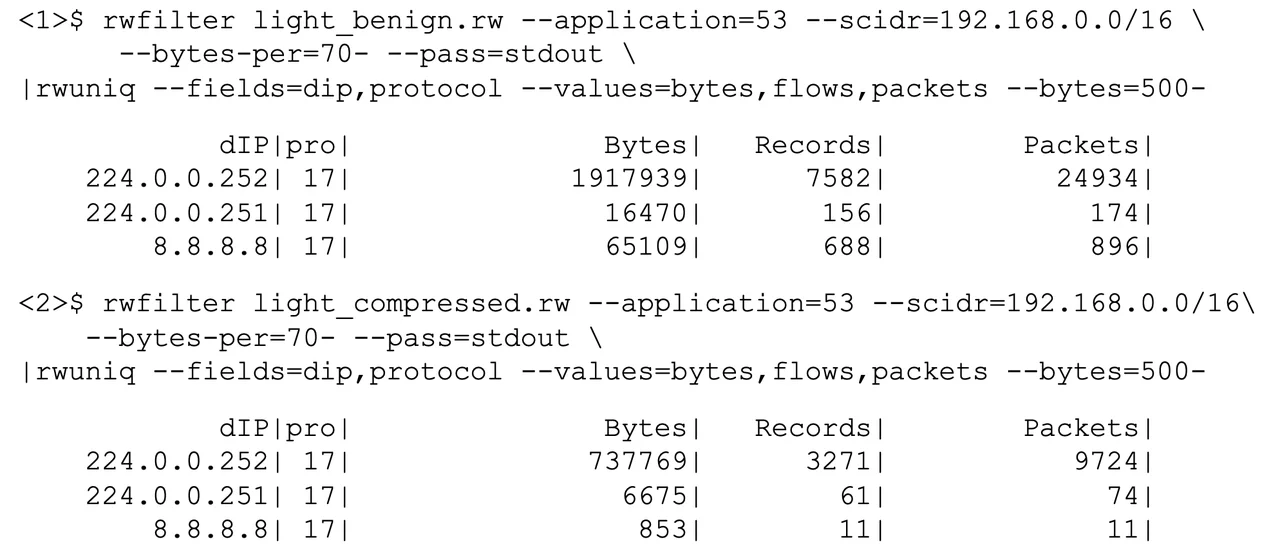
Determine 1 under presents a sequence of SiLK instructions to implement an analytic to detect exfiltration. The primary command applies a filter to regular, benign DNS site visitors, isolating DNS site visitors (recognized by protocol recognition as indicated by the appliance label of 53) coming from the inner community (classless inter-domain routing [CIDR] block 192.168.0.0/16) and of comparatively lengthy (70 bytes or extra) packets. The output of the filter is then summarized by vacation spot tackle and transport protocol, counting bytes, circulate data, and packets for every mixture of tackle and protocol. The ensuing counts are solely proven if the gathered bytes are 500 or extra. After making use of the analytic to benign DNS knowledge, it’s utilized within the second sequence to DNS knowledge encompassing compressed knowledge for exfiltration.
Determine 1: SiLK Analytic and Outcomes
The ends in Determine 1 present that the community talks to a main DNS server, a secondary DNS server, and a public server. Within the benign case, the information is especially directed to the first DNS server and the general public server. Within the exfiltration case, the information is especially directed to the first DNS server and the secondary DNS server. This shift of vacation spot, in isolation, just isn’t sufficient to make the exfiltration site visitors suspicious or present a foundation for transferring past suspicion into investigation. Within the benign case, there’s a notable fraction of the site visitors directed to the general public DNS server at 8.8.8.8. Within the site visitors labeled as abusive, this fraction is lessened, and the fraction to a personal DNS server (the exfiltration goal) at 224.0.0.252 is elevated. Sadly, given the restricted nature of SiLK circulate data, safety analysts have a tough time exfiltrating extra site visitors. To go additional, extra DNS-specific fields are required. These fields are supplied by deep packet inspection (DPI) knowledge in expanded circulate data in IPFIX format. Whereas SiLK can’t course of IPFIX circulate data, different instruments similar to Mothra and databases can.
Implementing the Analytic through Mothra
The code pattern under exhibits the analytic carried out in Spark utilizing the Mothra libraries. These libraries enable definition and loading of information frames with community circulate document knowledge in both SiLK or IPFIX format. A knowledge body is a assortment of information organized into named columns. Information frames could be manipulated by Spark features to isolate flows of curiosity and to summarize these flows. Defining the information frames entails figuring out the columns and the information to populate the columns. Within the code pattern, the information frames are outlined by the spark.learn.area perform and populated by knowledge from both the captured benign site visitors or the captured exfiltration site visitors through Mothra’s ipfix perform. Collectively, these features set up the knowledge knowledge body.
The consequence knowledge body is constructed from the knowledge knowledge body through a sequence of filtering and summarization features. The preliminary filter restricts it to site visitors labeled as DNS site visitors, adopted by one other filter that ensures the data include DNS useful resource document queries or responses. The choose perform that follows isolates particular document options for summarization: time, site visitors supply and vacation spot, byte and packet volumes, DNS names, DNS flags, and DNS useful resource document sorts. The groupBy perform generates the summarization for every distinctive DNS identify and useful resource document kind mixture. The agg perform specifies that the summarization include the depend of circulate data, the counts of supply and vacation spot IP addresses, and the totals for bytes and packets. The filter perform (after the summarization) restricts output to simply these exhibiting a bytes-per-packet ratio of greater than 70 with fewer than three entries within the DNS Identify listing. This final filter excludes summarizations of site visitors that’s giant solely because of the size of the response listing moderately than to the size of particular person queries.
This filtering and summarization course of creates a profile of huge DNS requests and responses (separated by DNS flag values). The usage of DNS names as a grouping worth permits the analytic to tell apart repeated queries to comparable domains. The counts of supply and vacation spot IP addresses enable the analyst to tell apart repeated site visitors to a couple areas as a substitute of uncommon site visitors to a number of areas or from a number of sources.
val data_dir = ".../path/to/knowledge"
import org.cert.netsa.mothra.datasources._
import org.cert.netsa.mothra.datasources.ipfix.IPFIXFields
import org.apache.spark.sql.features._

// In dnsIDBenign.sc:
val data_file = s"$data_dir/light_benign.ipfix"
// In dnsIDAbuse.sc:
// val data_file =
//   s"$data_dir/light_compressed.ipfix"

val knowledge = {
  spark.learn.fields(
    IPFIXFields.default, IPFIXFields.dpi.dns
  ).ipfix(data_file)
}


val consequence = {
  knowledge
    .filter(($"silkAppLabel" === 53) &&
            (measurement($"dnsRecordList")>0))
    .choose(
       $"startTime",
       $"sourceIPAddress",
       $"destinationIPAddress",
       $"octetCount",
       $"packetCount",
       $"dnsRecordList.dnsRRType" as "dnsRRType",
       $"dnsRecordList.dnsQueryResponse" as "dnsQR",
       $"dnsRecordList.dnsResponseCode" as "dnsResponse",
       $"dnsRecordList.dnsName" as "dnsName")
     .groupBy($"dnsName",$"dnsRRType")
     .agg(depend($"*") as "flows",
          countDistinct($"sourceIPAddress") as "#sIP",
          countDistinct($"destinationIPAddress") as "#dIP",
          sum($"octetCount") as "bytes",
          sum($"packetCount") as "packets")
 //    .filter($"packets" > 20)
     .filter($"bytes"/$"packets" > 70)
     .filter(measurement($"dnsName") < 3)
     .orderBy($"bytes".desc)
}
consequence.present(20,false)
The code pattern under exhibits the output of dnsIDExfil.sc on benign and on compressed knowledge, the information units used within the previous SiLK dialogue. The presence of multicast (224/8 and 239/8 CIDR blocks) and RFC1918 non-public addresses (192.168/16 CIDR blocks) is because of this knowledge coming from a synthetic assortment setting as a substitute of reside Web site visitors seize.
Contrasting the benign output in opposition to the abuse output, we see a smaller variety of lookup addresses being queried within the abuse outcomes and a a lot faster drop-off within the variety of queries per host. Within the benign outcomes, there are six DNSNames which might be queried repeatedly; within the abuse outcomes, there are two. All the queries proven are PTR (reverse. RRType=12) queries, and all are going to the identical server. Within the high-volume DNSName queries, the utmost common packet size is barely bigger for the abuse knowledge than for the benign knowledge (81 vs. 78). Taken collectively, these variations present a slow-and-steady launch of extra knowledge as a part of the DNS knowledge switch, which displays the file switch going down.
dnsIDBenign.sc output:
+-------------------------------------+---------+-----+----+----+------+-------+
|dnsName                              |dnsRRType|flows|#sIP|#dIP|bytes |packets|
+-------------------------------------+---------+-----+----+----+------+-------+
|[252.0.0.224.in-addr.arpa.]          |[12]     |2835 |1   |1   |416539|5901   |
|[150.20.168.192.in-addr.arpa.]       |[12]     |982  |1   |1   |242585|3125   |
|[200.20.168.192.in-addr.arpa.]       |[12]     |895  |1   |1   |134756|1836   |
|[15.20.168.192.in-addr.arpa.]        |[12]     |901  |1   |1   |133490|1844   |
|[100.20.168.192.in-addr.arpa.]       |[12]     |757  |1   |1   |112173|1533   |
|[2.20.168.192.in-addr.arpa.]         |[12]     |635  |1   |1   |91734 |1288   |
|[3.20.168.192.in-addr.arpa.]         |[12]     |315  |1   |1   |45438 |640    |
|[_ipps._tcp.local., _ipp._tcp.local.]|[12, 12] |122  |32  |1   |13161 |136    |
|[250.255.255.239.in-addr.arpa.]      |[12]     |74   |1   |1   |11328 |152    |
|[101.20.168.192.in-addr.arpa.]       |[12]     |31   |1   |1   |4666  |64     |
+-------------------------------------+---------+-----+----+----+------+-------+
solely exhibiting prime 10 rows

dnsIDAbuse.sc output:
+-------------------------------------+---------+-----+----+----+------+-------+
|dnsName                              |dnsRRType|flows|#sIP|#dIP|bytes |packets|
+-------------------------------------+---------+-----+----+----+------+-------+
|[252.0.0.224.in-addr.arpa.]          |[12]     |1260 |1   |1   |191398|2696   |
|[2.20.168.192.in-addr.arpa.]         |[12]     |255  |1   |1   |130725|1615   |
|[150.20.168.192.in-addr.arpa.]       |[12]     |416  |1   |1   |63606 |866    |
|[200.20.168.192.in-addr.arpa.]       |[12]     |388  |1   |1   |57686 |788    |
|[15.20.168.192.in-addr.arpa.]        |[12]     |379  |1   |1   |56492 |781    |
|[100.20.168.192.in-addr.arpa.]       |[12]     |340  |1   |1   |50738 |694    |
|[3.20.168.192.in-addr.arpa.]         |[12]     |125  |1   |1   |17750 |250    |
|[250.255.255.239.in-addr.arpa.]      |[12]     |32   |1   |1   |4736  |64     |
|[_ipps._tcp.local., _ipp._tcp.local.]|[12, 12] |46   |30  |1   |4467  |51     |
|[_ipp._tcp.local., _ipps._tcp.local.]|[12, 12] |13   |9   |1   |1782  |19     |
+-------------------------------------+---------+-----+----+----+------+-------+
solely exhibiting prime 10 rows
Understanding Information Exfiltration
Whichever type of tooling is used, analysts typically want an understanding of the information transfers from their community. Repetitive queries for DNS decision ought to be moderately uncommon—caching ought to get rid of many of those repetitions. As repetitive queries for decision are recognized, a number of teams of hosts could also be discovered:
- Hosts that generate repetitive queries not indicative of exfiltration of information are more likely to exist, characterised by very constant question measurement, periodic timing, and using anticipated identify servers.
- Hosts that generate repetitive queries with uncommon identify servers or timing might require additional investigation.
- Hosts that generate repetitive queries with uncommon identify servers or question sizes ought to be examined rigorously to determine potential exfiltration.
The influence of those hosts on community safety will differ relying on the vary and criticality of belongings these hosts entry, however a number of the site visitors might demand speedy response.
What Would possibly a Safety Analyst Need to Know
This publish is a part of a sequence addressing a easy query: What may a safety analyst wish to know in the beginning of every shift concerning the community? In every publish we are going to focus on one reply to this query and software of a wide range of instruments which will implement that reply. Our aim is to offer some key observations that assist analysts monitor and defend their networks, specializing in helpful ongoing measures, moderately than these particular to 1 occasion, incident, or difficulty.
We won’t concentrate on signature-based detection, since there are a number of sources for such together with intrusion detection methods (IDS)/intrusion prevention methods (IPS) and antivirus merchandise. The instruments utilized in these articles will primarily be a part of the CERT/NetSA Evaluation Suite, however we are going to embody different instruments if useful. Earlier posts examined instruments for monitoring software program updates and proxy bypass.
Our method will probably be to focus on a given analytic, focus on the motivation behind the analytic, and supply the appliance as a labored instance. The labored instance, by intention, is illustrative moderately than exhaustive. The choice of what analytics to deploy, and the way, is left to the reader.
If there are particular behaviors that you just want to counsel, please ship them by e mail to netsa-help@cert.org with “SOC Analytics Concept” within the topic line.
[ad_2]