



Subject clusters and recommender methods will help web optimization specialists to construct a scalable inner linking structure.
And as we all know, inner linking can impression each person expertise and search rankings. It’s an space we wish to get proper.
On this article, we are going to use Wikipedia knowledge to construct subject clusters and recommender methods with Python and the Pandas knowledge evaluation software.
To attain this, we are going to use the Scikit-learn library, a free software program machine studying library for Python, with two fundamental algorithms:
- TF-IDF: Time period frequency-inverse doc frequency.
- NMF: Non-negative matrix factorization, which is a bunch of algorithms in multivariate evaluation and linear algebra that can be utilized to investigate dimensional knowledge.
Particularly, we are going to:
- Extract all the hyperlinks from a Wikipedia article.
- Learn textual content from Wikipedia articles.
- Create a TF-IDF map.
- Break up queries into clusters.
- Construct a recommender system.
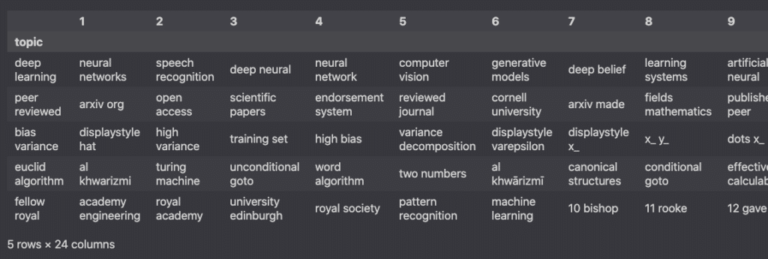
Right here is an instance of subject clusters that it is possible for you to to construct:
 Screenshot from Pandas, February 2022
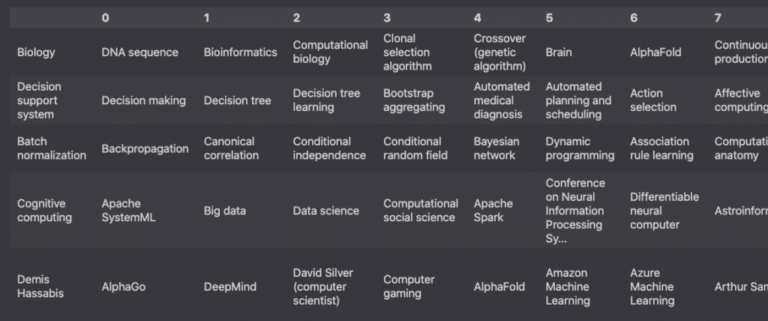
Furthermore, right here’s the overview of the recommender system you could recreate.
 Screenshot from Pandas, February 2022
Prepared? Let’s get just a few definitions and ideas you’ll wish to know out of the best way first.
The Distinction Between Subject Clusters & Recommender Programs
Subject clusters and recommender methods may be constructed in numerous methods.
On this case, the previous is grouped by IDF weights and the latter by cosine similarity.
In easy web optimization phrases:
- Subject clusters will help to create an structure the place all articles are linked to.
- Recommender methods will help to create an structure the place essentially the most related pages are linked to.
What Is TF-IDF?
TF-IDF, or time period frequency-inverse doc frequency, is a determine that expresses the statistical significance of any given phrase to the doc assortment as an entire.
TF-IDF is calculated by multiplying time period frequency and inverse doc frequency.
TF-IDF = TF * IDF
- TF: Variety of occasions a phrase seems in a doc/variety of phrases within the doc.
- IDF: log(Variety of paperwork / Variety of paperwork that comprise the phrase).
As an instance this, let’s take into account this case with Machine Studying as a goal phrase:
- Doc A incorporates the goal phrase 10 occasions out of 100 phrases.
- In the whole corpus, 30 paperwork out of 200 paperwork additionally comprise the goal phrase.
Then, the formulation can be:
TF-IDF = (10/100) * log(200/30)
What TF-IDF Is Not
TF-IDF isn’t one thing new. It’s not one thing that it’s worthwhile to optimize for.
In response to John Mueller, it’s an previous data retrieval idea that isn’t value specializing in for web optimization.
There may be nothing in it that may assist you outperform your opponents.
Nonetheless, TF-IDF may be helpful to SEOs.
Studying how TF-IDF works offers perception into how a pc can interpret human language.
Consequently, one can leverage that understanding to enhance the relevancy of the content material utilizing related methods.
What Is Non-negative Matrix Factorization (NMF)?
Non-negative matrix factorization, or NMF, is a dimension discount method usually utilized in unsupervised studying that mixes the product of non-negative options right into a single one.
On this article, NMF will probably be used to outline the variety of matters we wish all of the articles to be grouped below.
Definition Of Subject Clusters
Subject clusters are groupings of associated phrases that may assist you create an structure the place all articles are interlinked or on the receiving finish of inner hyperlinks.
Definition Of Recommender Programs
Recommender methods will help to create an structure the place essentially the most related pages are linked to.
Constructing A Subject Cluster
Subject clusters and recommender methods may be constructed in numerous methods.
On this case, subject clusters are grouped by IDF weights and the Recommender methods by cosine similarity.
Extract All The Hyperlinks From A Particular Wikipedia Article
Extracting hyperlinks on a Wikipedia web page is finished in two steps.
First, choose a selected topic. On this case, we use the Wikipedia article on machine studying.
Second, use the Wikipedia API to seek out all the inner hyperlinks on the article.
Right here is tips on how to question the Wikipedia API utilizing the Python requests library.
import requests

main_subject="Machine studying"

url="https://en.wikipedia.org/w/api.php"
params = {
        'motion': 'question',
        'format': 'json',
        'generator':'hyperlinks',
        'titles': main_subject,
        'prop':'pageprops',
        'ppprop':'wikibase_item',
        'gpllimit':1000,
        'redirects':1
        }

r = requests.get(url, params=params)
r_json = r.json()
linked_pages = r_json['query']['pages']

page_titles = [p['title'] for p in linked_pages.values()]
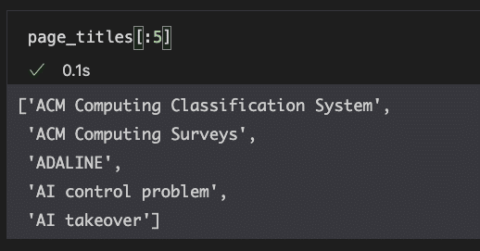
Eventually, the result’s an inventory of all of the pages linked from the preliminary article.
-
 Screenshot from Pandas, February 2022
These hyperlinks characterize every of the entities used for the subject clusters.
Choose A Subset Of Articles
For efficiency functions, we are going to choose solely the primary 200 articles (together with the principle article on machine studying).
# choose first X articles
num_articles = 200
pages = page_titles[:num_articles]

# be sure to maintain the principle topic on the listing
pages += [main_subject]

# be sure there aren't any duplicates on the listing
pages = listing(set(pages))
Learn Textual content From The Wikipedia Articles
Now, we have to extract the content material of every article to carry out the calculations for the TF-IDF evaluation.
To take action, we are going to fetch the API once more for every of the pages saved within the pages variable.
From every response, we are going to retailer the textual content from the web page and add it to an inventory known as text_db.
Observe that you could be want to put in tqdm and lxml packages to make use of them.
import requests
from lxml import html
from tqdm.pocket book import tqdm

text_db = []
for web page in tqdm(pages):
    response = requests.get(
            'https://en.wikipedia.org/w/api.php',
            params={
                'motion': 'parse',
                'web page': web page,
                'format': 'json',
                'prop':'textual content',
                'redirects':''
            }
        ).json()

    raw_html = response['parse']['text']['*']
    doc = html.document_fromstring(raw_html)
    textual content=""
    for p in doc.xpath('//p'):
        textual content += p.text_content()
    text_db.append(textual content)
print('Achieved')
This question will return an inventory through which every ingredient characterize the textual content of the corresponding Wikipedia web page.
## Print variety of articles
print('Variety of articles extracted: ', len(text_db))
Output:
Variety of articles extracted: 201
As we are able to see, there are 201 articles.
It’s because we added the article on “Machine studying” on high of the highest 200 hyperlinks from that web page.
Moreover, we are able to choose the primary article (index 0) and browse the primary 300 characters to achieve a greater understanding.
# learn first 300 characters of 1st article
text_db[0][:300]
Output:
'nBiology is the scientific examine of life.[1][2][3] It's a pure science with a broad scope however has a number of unifying themes that tie it collectively as a single, coherent area.[1][2][3] As an example, all organisms are made up of cells that course of hereditary data encoded in genes, which may '
Create A TF-IDF Map
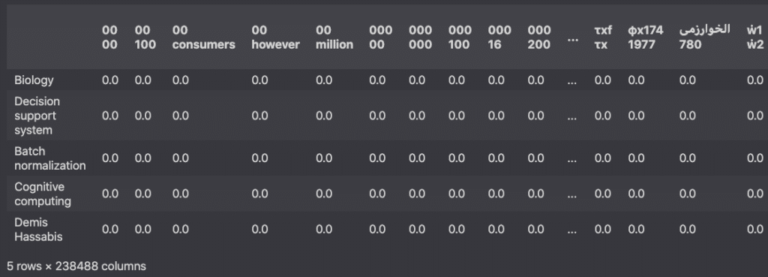
On this part, we are going to depend on pandas and TfidfVectorizer to create a Dataframe that incorporates the bi-grams (two consecutive phrases) of every article.
Right here, we’re utilizing TfidfVectorizer.
That is the equal of utilizing CountVectorizer adopted by TfidfTransformer, which you may even see in different tutorials.
As well as, we have to take away the “noise”. Within the area of Pure Language Processing, phrases like “the”, “a”, “I”, “we” are known as “stopwords”.
Within the English language, stopwords have low relevancy for SEOs and are overrepresented in paperwork.
Therefore, utilizing nltk, we are going to add an inventory of English stopwords to the TfidfVectorizer class.
import pandas as pd
from sklearn.feature_extraction.textual content import TfidfVectorizer
from nltk.corpus import stopwords

# Create an inventory of English stopwords
stop_words = stopwords.phrases('english')

# Instantiate the category
vec = TfidfVectorizer(
    stop_words=stop_words,
    ngram_range=(2,2), # bigrams
    use_idf=True
    )

# Practice the mannequin and rework the information
tf_idf =  vec.fit_transform(text_db)

# Create a pandas DataFrame
df = pd.DataFrame(
    tf_idf.toarray(),
    columns=vec.get_feature_names(),
    index=pages
    )

# Present the primary traces of the DataFrame
df.head()
 Screenshot from Pandas, February 2022
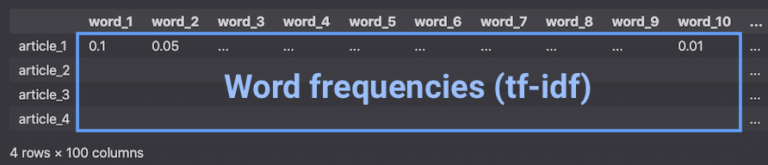
Within the DataFrame above:
- Rows are the paperwork.
- Columns are the bi-grams (two consecutive phrases).
- The values are the phrase frequencies (tf-idf).
 Screenshot from Pandas, February 2022
Kind The IDF Vectors
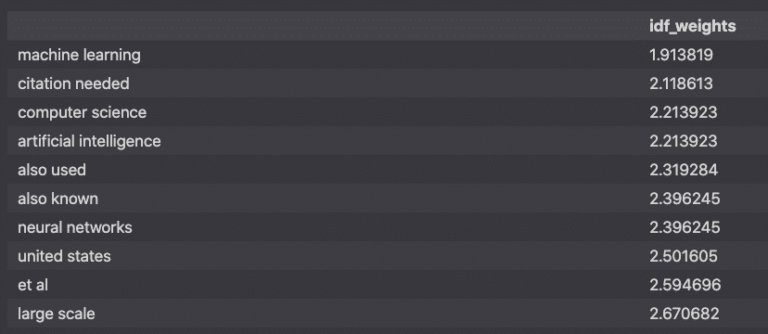
Under, we’re sorting the Inverse doc frequency vectors by relevance.
idf_df = pd.DataFrame(
    vec.idf_,
    index=vec.get_feature_names(),
    columns=['idf_weigths']
    )

idf_df.sort_values(by=['idf_weigths']).head(10)
 Screenshot from Pandas, February 2022
Particularly, the IDF vectors are calculated from the log of the variety of articles divided by the variety of articles containing every phrase.
The better the IDF, the extra related it’s to an article.
The decrease the IDF, the extra frequent it’s throughout all articles.
- 1 point out out of 1 articles = log(1/1) = 0.0
- 1 point out out of two articles = log(2/1) = 0.69
- 1 point out out of 10 articles = log(10/1) = 2.30
- 1 point out out of 100 articles = log(100/1) = 4.61
Break up Queries Into Clusters Utilizing NMF
Utilizing the tf_idf matrix, we are going to cut up queries into topical clusters.
Every cluster will comprise carefully associated bi-grams.
Firstly, we are going to use NMF to scale back the dimensionality of the matrix into matters.
Merely put, we are going to group 201 articles into 25 matters.
from sklearn.decomposition import NMF
from sklearn.preprocessing import normalize

# (non-obligatory) Disable FutureWarning of Scikit-learn
from warnings import simplefilter
simplefilter(motion='ignore', class=FutureWarning)

# choose variety of subject clusters
n_topics = 25

# Create an NMF occasion
nmf = NMF(n_components=n_topics)

# Match the mannequin to the tf_idf
nmf_features = nmf.fit_transform(tf_idf)

# normalize the options
norm_features = normalize(nmf_features)
We are able to see that the variety of bigrams stays the identical, however articles are grouped into matters.
# Examine processed VS unprocessed dataframes
print('Authentic df: ', df.form)
print('NMF Processed df: ', nmf.components_.form)
Secondly, for every of the 25 clusters, we are going to present question suggestions.
# Create clustered dataframe the NMF clustered df
elements = pd.DataFrame(
    nmf.components_,
    columns=[df.columns]
    )

clusters = {}

# Present high 25 queries for every cluster
for i in vary(len(elements)):
    clusters[i] = []
    loop = dict(elements.loc[i,:].nlargest(25)).objects()
    for ok,v in loop:
        clusters[i].append({'q':ok[0],'sim_score': v})
Thirdly, we are going to create a knowledge body that reveals the suggestions.
# Create dataframe utilizing the clustered dictionary
grouping = pd.DataFrame(clusters).T
grouping['topic'] = grouping[0].apply(lambda x: x['q'])
grouping.drop(0, axis=1, inplace=True)
grouping.set_index('subject', inplace=True)

def show_queries(df):
    for col in df.columns:
        df[col] = df[col].apply(lambda x: x['q'])
    return df

# Solely show the question within the dataframe
clustered_queries = show_queries(grouping)
clustered_queries.head()
Lastly, the result’s a DataFrame displaying 25 matters together with the highest 25 bigrams for every subject.
Screenshot from Pandas, February 2022Constructing A Recommender System
Now, as an alternative of constructing subject clusters, we are going to now construct a recommender system utilizing the identical normalized options from the earlier step.
The normalized options are saved within the norm_features variable.
# compute cosine similarities of every cluster
knowledge = {}
# create dataframe
norm_df = pd.DataFrame(norm_features, index=pages)
for web page in pages:
    # choose web page suggestions
    suggestions = norm_df.loc[page,:]

    # Compute cosine similarity
    similarities = norm_df.dot(suggestions)

    knowledge[page] = []
    loop = dict(similarities.nlargest(20)).objects()
    for ok, v in loop:
        if ok != web page:
            knowledge[page].append({'q':ok,'sim_score': v})
What the code above does is:
- Loops by every of the pages chosen firstly.
- Selects the corresponding row within the normalized dataframe.
- Computes the cosine similarity of all of the bigram queries.
- Selects the highest 20 queries sorted by similarity rating.
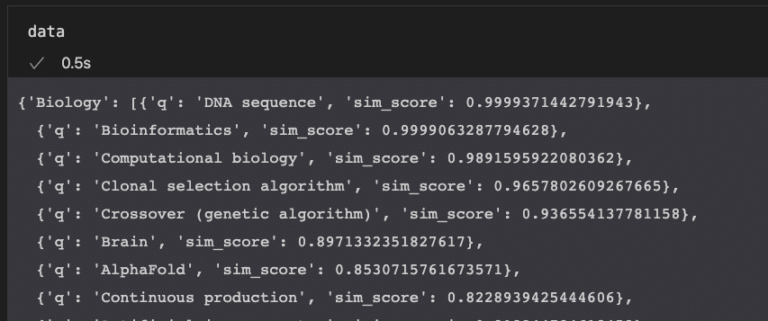
After the execution, we’re left with a dictionary of pages containing lists of suggestions sorted by similarity rating.
 Screenshot from Pandas, February 2022
The subsequent step is to transform that dictionary right into a DataFrame.
# convert dictionary to dataframe
recommender = pd.DataFrame(knowledge).T

def show_queries(df):
    for col in df.columns:
        df[col] = df[col].apply(lambda x: x['q'])
    return df

show_queries(recommender).head()
The ensuing DataFrame reveals the mother or father question together with sorted advisable matters in every column.
Screenshot from Pandas, February 2022Voilà!
We’re accomplished constructing our personal recommender system and subject cluster.
Attention-grabbing Contributions From The web optimization Group
I’m a giant fan of Daniel Heredia, who has additionally performed round with TF-IDF by discovering related phrases with TF IDF, textblob, and Python.
Python tutorials may be daunting.
A single article is probably not sufficient.
If that’s the case, I encourage you to learn Koray Tuğberk GÜBÜR’s tutorial, which exposes an analogous manner to make use of TF-IDF.
Billy Bonaros additionally got here up with a artistic software of TF-IDF in Python and confirmed tips on how to create a TF-IDF key phrase analysis software.
Conclusion
In the long run, I hope you will have realized a logic right here that may be tailored to any web site.
Understanding how subject clusters and recommender methods will help enhance a web site’s structure is a worthwhile ability for any web optimization professional wishing to scale your work.
Utilizing Python and Scikit-learn, you will have realized tips on how to construct your individual – and have realized the fundamentals of TF-IDF and of non-negative matrix factorization within the course of.
Extra assets:
Featured Picture: Kateryna Reka/Shutterstock
[ad_2]

